


Given an integer n, return a list of all possible full binary trees with n nodes. Each node of each tree in the answer must have Node.val == 0.
Each element of the answer is the root node of one possible tree. You may return the final list of trees in any order.
A full binary tree is a binary tree where each node has exactly 0 or 2 children.
Example 1:
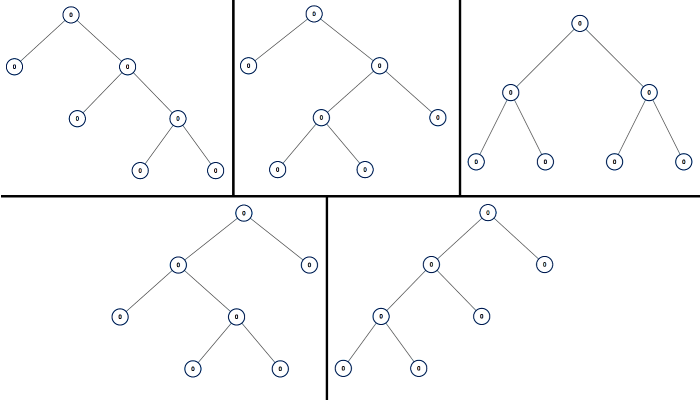
Input: n = 7
Output: [[0,0,0,null,null,0,0,null,null,0,0],[0,0,0,null,null,0,0,0,0],[0,0,0,0,0,0,0],[0,0,0,0,0,null,null,null,null,0,0],[0,0,0,0,0,null,null,0,0]]
Example 2:
Input: n = 3
Output: [[0,0,0]]
Constraints:
1 <= n <= 20
给你一个整数 n ,请你找出所有可能含 n 个节点的 真二叉树 ,并以列表形式返回。答案中每棵树的每个节点都必须符合 Node.val == 0 。
答案的每个元素都是一棵真二叉树的根节点。你可以按 任意顺序 返回最终的真二叉树列表。
真二叉树 是一类二叉树,树中每个节点恰好有 0 或 2 个子节点。
示例 1:
输入:n = 7
输出:[[0,0,0,null,null,0,0,null,null,0,0],[0,0,0,null,null,0,0,0,0],[0,0,0,0,0,0,0],[0,0,0,0,0,null,null,null,null,0,0],[0,0,0,0,0,null,null,0,0]]
示例 2:
输入:n = 3
输出:[[0,0,0]]
提示:
1 <= n <= 20
| Language | Runtime | Memory | Submission Time |
|---|---|---|---|
| javascript | 224 ms | 27.8 MB | 2019/01/31 17:40 |
/**
 * Definition for a binary tree node.
 * function TreeNode(val) {
 *     this.val = val;
 *     this.left = this.right = null;
 * }
 */
/**
 * @param {number} N
 * @return {TreeNode[]}
 */
var allPossibleFBT = function(N) {
    if (N % 2 === 0) return [];
    if (N === 1) return [new TreeNode(0)];
    var trees = [];

    for (var i = 1; i <= N - 2; i+=2) {
        const left = allPossibleFBT(i);
        const right = allPossibleFBT(N - 1 - i);

        for (var j=0; j<left.length; j++) {
            for (var k=0; k<right.length;k++) {
                var current = new TreeNode(0);
                current.left = left[j];
                current.right = right[k];
                trees.push(current);
            }
        }
    }
    return trees;
};递归思路。可以画一下图,递归n === 1, n === 3, n === 5 的情况方便理解。
递归出口为 n === 1 的时候。
new 一个节点,递归左右子树,得到左右子树所有可能的满二叉树。然后这些子树分别与这个根结点组合就行。一个双重循环搞定。