KineticGas is an implementation of Revised Enskog Theory (RET) for spherical potentials. The most notable of which is the implementation of RET-Mie, the Revised Enskog Theory for Mie fluids.
The package is implemented mostly in C++ to handle the numerical computations involved in evaluating the collision integrals and the radial distribution function at contact for the target fluids, with the possibility of setting up multithreading at compile time.
KineticGas can be used to predict diffusion coefficients, thermal diffusion coefficients, viscosities and thermal conductivities in gas mixtures, and is reliable over a large range of temperatures and pressures. The package also contains an extensive database of fluid parameters collected from the open literature.
The full documentation, with installation- and getting started-guides can be found on the KineticGas homepage.
This readme is only intended to provide a minimal introduction, and may be out-of-sync with the pykingas version currently
on PyPI.
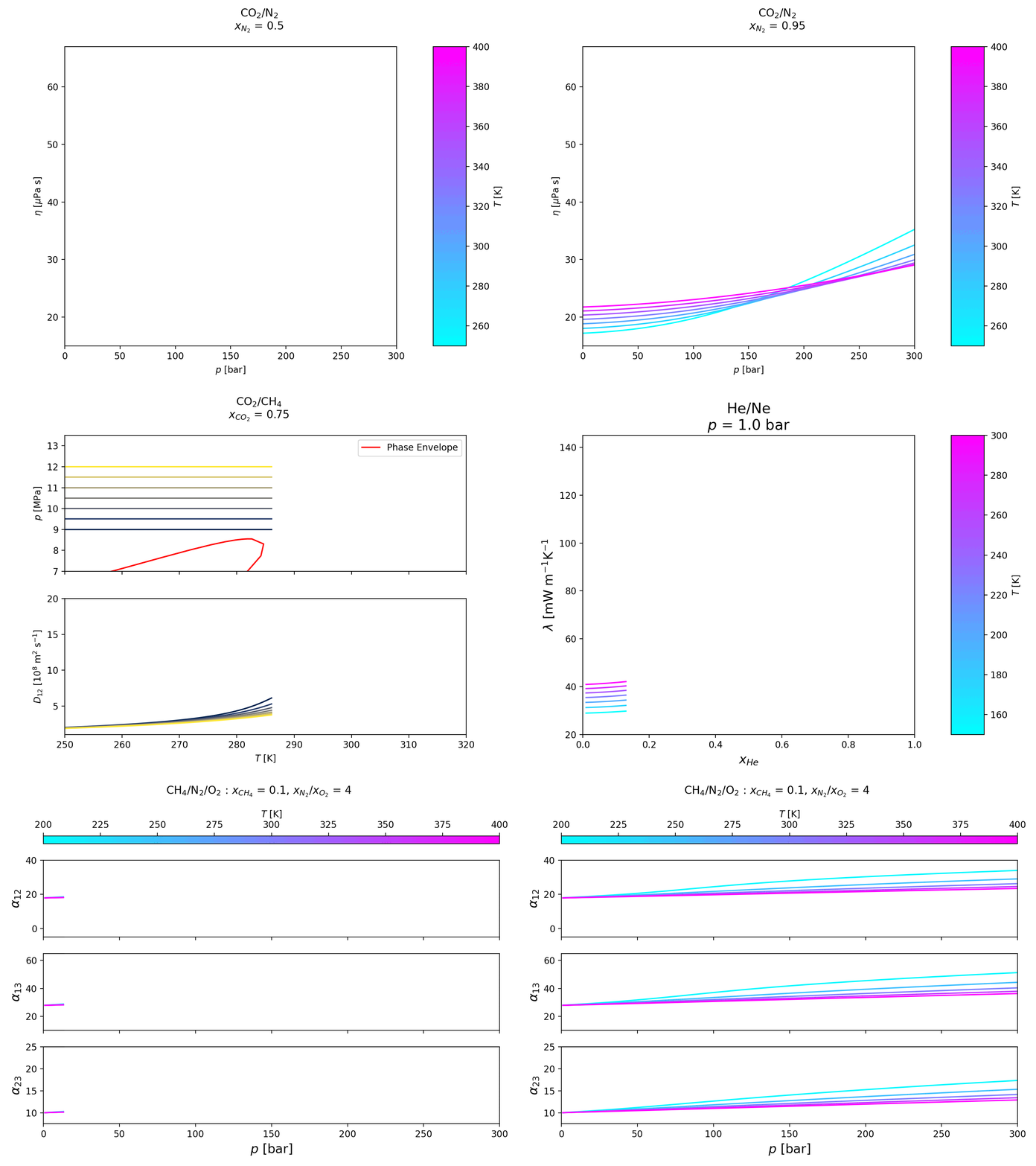
- Installing KineticGas
- Getting started
- Advanced usage
- Program structure
- File system
- Fluid indentifiers
KineticGas has been developed throughout several works. If you are referencing the package, please cite one or more of the associated works
- General usage
- Revised Enskog theory for Mie fluids: Prediction of diffusion coefficients, thermal diffusion coefficients, viscosities and thermal conductivities (Vegard G. Jervell and Øivind Wilhelmsen, J. Chem. Phys. 2023)
- Predicting viscosities and thermal conductivities from dilute gas to dense liquid: Deriving fundamental transfer lengths for momentum and energy exchange in revised Enskog theory (V. G. Jervell and Ø. Wilhelmsen, J. Chem. Phys. 2024)
- The Kinetic Gas theory of Mie fluids (Vegard G. Jervell, 2022)
- Connection to Non-Equilibrium thermodynamics (Onsager coefficients)
- The influence of thermal diffusion on water migration through a porous insulation material (V. G. Jervell, M. Aa. Gjennestad, T. T. Trinh, Ø. Wilhelmsen, Int. J. Heat Mass Transfer, 2024)
- Transfer Lengths, the EWCA model
- Predicting viscosities and thermal conductivities from dilute gas to dense liquid: Deriving fundamental transfer lengths for momentum and energy exchange in revised Enskog theory (V. G. Jervell and Ø. Wilhelmsen, J. Chem. Phys. 2024)
- The Lennard-Jones spline fluid
- Viscosity, thermal conductivity and self-diffusion coefficient of the Lennard Jones spline fluid: Evaluation of theories for a short-ranged potential (J. S. Løken, V. G. Jervell, M. Hammer, B. Hafskjold, T. T. Trinh and Ø. Wilhelmsen, 2025)
- Revised Enskog theory and extended corresponding states models for the transport properties of the Lennard-Jones/spline fluid (Johannes S. Løken, 2025)
- Quantum mechanical methods and Feynman-Hibbs corrections
- The limits of Feynman–Hibbs corrections in capturing quantum-nuclear contributions to thermophysical properties (V. G. Jervell and Ø. Wilhelmsen, J. Chem. Phys. 2025)
- Ab initio reference potentials
- Argon, Neon, Hydrogen and Helium: The limits of Feynman–Hibbs corrections in capturing quantum-nuclear contributions to thermophysical properties (V. G. Jervell and Ø. Wilhelmsen, J. Chem. Phys. 2025)
Cite this repository as
@article{kineticgas_repo,
  title={{ThermoTools: KineticGas}},
  author={Vegard Gjeldvik Jervell and Johannes Salomonsen L{\o}ken},
  year={2025},
  howpublished={github.com/thermotools/kineticgas}
}This implementation of the Revised Enskog solutions is build upon the work presented by M. López de Haro, E. D. G. Cohen, and J. Kincaid in the series of papers The Enskog Theory for multicomponent mixtures I - IV, J. Chem. Phys. (1983 - 1987) (I, II, III, IV).
The implementation utilises the explicit summational expressions for the square bracket integrals published by Tompson, Tipton and Loyalka in Chapman–Enskog solutions to arbitrary order in Sonine polynomials I - IV (Physica A, E. J. Mech. - B) 2007-2009 (I, II, III, IV).
The work by T. Lafitte, A. Apostolakou, C. Avendaño, A. Galindo, C. Adjiman, E. Müller and G. Jackson, Accurate statistical associating fluid theory for chain molecules formed from Mie segments J. Chem. Phys. 2013 is also of great importance to this implementation.
The KineticGas package is distributed as free software under the MIT licence.
KineticGas is available on PyPi as the pykingas package, for python versions 3.8-3.11, compiled for MacOS running on Apple Silicon, Linux and Windows.
In addition, wheels versions of KineticGas > 2.0.0 for macOS, Linux and Windows, as well as wheels for the latest version on GitHub can be downloaded here. Instructions for installing with pip directly from a downloaded wheel are provided at the linked page.
For MacOS running on Intel, or other operating systems, KineticGas must currently be built from source or installed from one of the distributed wheels linked above.
A KineticGas C++ library is available, and can be built using cmake and make.
The Python package dependencies are listed in the pyproject.toml file in the root directory of the package.
To compile the binary that is called from the python wrapper, pybind11 is required. pybind11 is included in cpp/external as a git submodule, so cloning the KineticGas repository should provide you with the files you need.
A standalone C++ module, that works without the python wrapper is currently under development. See the branch pure_cpp/ for the most up-to-date version there.
Python wheels for the latest version of KineticGas on main are built for macOS and Windows using cibuildwheels, and distributed here.
A build system using cmake and make is set up to support Mac, Linux and Windows.
If all goes well, running
git clone https://github.com/thermotools/KineticGas.git
cd KineticGas
git submodule update --init --recursive
mkdir build
cd build
cmake ..
make install
pip install ..
make sure to activate a virtual environment first if you want to avoid doing system-level installs.
The dynamic library libpykingas will be built and installed to the pykingas directory, additionally, the fluids directory containing the fluid parameter database is copied into the pykingas directory.
Note: The build system has been changed relatively recently, and is less tested than the build system that was used in the 2.0.0 release. If you encounter issues, please don't hesitate to post an issue on github so that we can improve robustness.
- Warning that thermopack is not installed
- The easiest way to obtain the
ThermoPackdynamic library (whichKineticGasneeds) is likely to download the appropriate zip file here, unzip it, and set the environment variableTHERMOPACK_DIRto the resulting directory (wherethermopack-config.cmakeis located).- On Linux and macOS:
export THERMOPACK_DIR=/path/to/thermopack-<system>/ - On Windows (powershell):
$THERMOPACK_DIR = C:\path\to\thermopack-<system>\thermopack-<system> - To check that it is set correctly:
ls ${THERMOPACK_DIR}should give a list of files includingthermopack-config.cmake.
- On Linux and macOS:
- The
KineticGaslibrary has a dependency on theThermoPackC++ wrapper. If you have not installed thermopack, the build system will generate a target from thethermopacksubmodule. Runningmake installshould build and install this target, re-runningcmake ..after building and installingthermopackshould then give output telling you thatthermopackhas been found and is installed. - If you have installed thermopack, run
export THERMOPACK_DIR=<path/to/thermopack>, to helpcmakefind your installation.
- The easiest way to obtain the
The KineticGas C++ library is built using cmake and make. All dependencies are included as git submodules under cpp/external, and should be properly retrieved when you clone the KineticGas repository and run git submodule update --init --recursive.
Note: KineticGas depends on ThermoPack. If an installation of ThermoPack is not found, the build system will attempt to compile it as part of the build process. If you already have an installation of ThermoPack, setting the environment variable THERMOPACK_DIR to the root directory of ThermoPack (where thermopack-config.cmake is found), that installation of ThermoPack will be used istead of re-compiling. You can also download a binary distribution of ThermoPack at the ThermoPack repository.
If all goes well, you should be able to build the KineticGas C++ library by running
git clone https://github.com/thermotools/KineticGas.git
cd KineticGas
git submodule update --init --recursive
mkdir build
cd build
cmake -Dpurecpp=ON -Dpylib=OFF ..
make install
This will provide you with the lib/libkineticgas.[so/dylib/dll] dynamic library, and the minimal example program build/run_kineticgas, which is built from the source file at cpp/run_kineticgas.cpp.
By default, KineticGas will search for fluid files at the relative path ../fluids (relative to the location of the libkineticgas dynamic library). This default search path can be changed by building with
cmake -DFLUID_DIR=<path/to/fluids> ..where supplying a relative path will result in the library searching for fluid files in the path relative to it's location (KineticGas/lib). Supplying absolute paths is also supported. To check
or change where your compiled KineticGas library is searching for fluid files, use the [get/set]_fluid_dir functions with signatures
// In utils.h
void set_fluid_dir(const std::string path); // supports both absolute and relative paths (relative to dynamic library location).
std::string get_fluid_dir(); // Current search path for fluid filesAn example program with a CMakeLists.txt demonstrating how you can include and link to the KineticGas library once it is installed is found in KineticGas/cppExamples.
In short terms: Setting the environment variable KINETICGAS_DIR to the top-level directory of the KineticGas package (where kineticgas-config.cmake is found), should allow cmake to find the library using find_library(KINETICGAS). Some convenience variables are set once the library is found:
KINETICGAS_ROOT: Path to root directory of the packageKINETICGAS_INSTALLED:TRUEif the dynamic library is found in the correct install location,FALSEotherwiseKINETICGAS_LIB: Path to thelibkineticgasdynamic libraryKINETICGAS_INCLUDE: List of include paths needed to include the kineticgas headers and dependencieskineticgas: Exported target, linking to this target should automatically add the appropriate directories to your include path.
In addition to this explanation, some examples may be found in the pyExamples directory.
The available models are HardSphere - The RET for Hard Spheres, MieKinGas - The RET-Mie. They are initialised by passing the appropriate component identifiers to the class constructors.
from pykingas.HardSphere import HardSphere
from pykingas.MieKinGas import MieKinGas

mie = MieKinGas('CO2,C1') # RET-Mie for CO2/CH4 mixture
hs = HardSphere('AR,KR,XE') # RET-HS for Ar/Kr/He mixture
The component identifiers are equivalent to the file names in the pykingas/fluids directory, and are consistent with the identifiers used by ThermoPack. A list of all available fluids and their identifiers can be found in the Fluid identifiers section.
If we wish to pass specific parameters to the models, this is done through various keyword arguments, as
# Continued
mie = MieKinGas('LJF,LJF', mole_weights=[5, 10], sigma=[2.5e-10, 3e-10], eps_div_k=[150, 200], la=[6, 7], lr=[12, 13])
the mole_weights argument sets the molar masses of the components, the sigma argument sets the mie-potential eps_div_k argument sets the mie-potential la argument sets the attractive exponents (lr argument sets the repulsive exponents (
Classes will only accept keyword arguments that are relevant to them, i.e.
hs = HardSphere('LJF,LJF', eps_div_k=[100, 200]) # Throws an errorwill throw an error.
To specify the parameters for only one component, and use default parameters for another, set the parameter for the components that are to use default values to None, as
# Continued
mie = MieKinGas('AR,KR', la=[None, 7], lr=[None, 14]) # Uses the default values for Ar, and specified values for Kr
mie = MieKinGas('AR,KR', la=[6, None], lr=[None, 14]) # Uses default la for Kr, and default lr for Ar.
For isotopic mixtures, one can specify masses in the same way
from pykingas.MieKinGas import MieKinGas
mie = MieKinGas('CH4,CH4,CH4,CH4', mole_weights=[16, 17, 18, 19]) # Isotopic mixture of 1-, 2-, 3-, and 4 times deuterised methaneKineticGas uses an Equation of State (EoS) internally to compute the derivatives of chemical potential with respect to molar density. Additionally, the tp-inteface methods for predicting transport coefficients use the EoS to compute molar volume at a given T, p, x. This each models stores its own equation of state in the self.eos attribute. By default, this is a ThermoPack equation of state object, which can be specified using the use_eos kwarg upon initialization, as
from pykingas.MieKinGas import MieKinGas
from thermopack.cubic import cubic

comps = 'AR,H2O' # The components we wish to model
eos = cubic(comps, 'SRK') # Soave-Redlich-Kwong EoS for Argon-water mixture
mie = MieKinGas(comps, use_eos=eos)
This can be useful if the components to be modeled do not have parameters for the default eos (thermopack.saftvrmie for MieKinGas), or if one wishes to use some other eos.
In the latter case, the only requirement is that the EoS object implements a method with signature equivalent to thermopack's chemical_potential_tv. If the tp-interface is to be used, the object must also implement a method with signature equivalent to thermopack's specific_volume.
Properties at infinite dilution can be of interest. Note that at infinite dilution, viscosity, thermal conductivity, and the thermal diffusion factor are independent of density, while the diffusion coefficient and thermal diffusion coefficient are inversely proportional to the density. To initialize a model where the species have negligible covolume (i.e. the radial distribution function is uniformly equal to one), set the kwarg is_idealgas=True, as
from pykingas.MieKinGas import MieKinGas
mie = MieKinGas('H2', is_idealgas=True) # Properties of hydrogen at infinite dilutionWhen working in reduced (Lennard-Jones) units
In addition to the methods here, a Tp-interface exists for the same methods, consisting of the methods thermal_conductivity_tp, viscosity_tp, interdiffusion_tp, theramal_diffusion_coeff_tp and thermal_diffusion_factor_tp. These methods are only wrappers for ease of use, that use the internal equation of state of the object (self.eos) to compute the molar volume at given (T, p, x) (assuming vapour phase), and passes the call to the methods documented here. Those methods have signatures equivalent to these, but with molar volume swapped out for pressure.
Please note that the Enskog solutions are explicit in density (not pressure), such that when making predictions as a function of pressure, an accurate equation of state is required to translate from a (T, V, n) state to a (T, p, n) state.
Thermal conductivities are predicted with the method thermal_conductivity(self, T, Vm, x, N=None), where T is the temperature, Vm is the molar volume, x is the molar composition and N is the Enskog approximation order.
Example:
from pykingas.MieKinGas import MieKinGas

kin = MieKinGas('O2,N2,CO2,C1') # Mixture of air with carbon dioxide and methane, modeled with RET-Mie
T = 800 # Kelvin
Vm = 0.0665 # cubic meter per mole, approximately equivalent to a pressure of 1 bar
x = [0.05, 0.25, 0.5, 0.2] # Molar composition

cond = kin.thermal_conductivity(T, Vm, x, N=2) # Thermal conductivity [W / m K]
Shear viscosities are predicted with the method viscosity(self, T, Vm, x, N=None), where T is the temperature, Vm is the molar volume, x is the molar composition and N is the Enskog approximation order.
Example:
from pykingas.MieKinGas import MieKinGas

kin = MieKinGas('O2,N2,CO2,C1') # Mixture of air with carbon dioxide and methane, modeled with RET-Mie
T = 800 # Kelvin
Vm = 0.0665 # cubic meter per mole, approximately equivalent to a pressure of 1 bar
x = [0.05, 0.25, 0.5, 0.2] # Molar composition

visc = kin.viscosity(T, Vm, x, N=2) # Shear viscosity [Pa s]
Diffusion coefficients may be defined in many different ways, and depend upon the frame of reference (FoR). For a more in-depth discussion on this see the supporting information of Revised Enskog Theory for Mie fluids: Prediction of diffusion coefficients, thermal diffusion coefficients, viscosities and thermal conductivities. For more details on the definitions available in the KineticGas package, see the memo on definitions of the diffusion coefficient.
The interface to all diffusion coefficients is the method interdiffusion(self, T, Vm, x, N), where T is the temperature, Vm is the molar volume, x is the molar composition and N is the Enskog approximation order.
The default definition of the diffusion coefficient is
where
The common Fickean diffusion coefficient. The diffusion coefficients are then computed as
from pykingas.MieKinGas import MieKinGas

kin = MieKinGas('AR,KR') # RET-Mie for a mixture of argon and krypton
T = 300 # Kelvin
Vm = 0.025 # cubic meter per mole, approximately equivalent to a pressure of 1 bar
x = [0.3, 0.7] # Molar composition

D = kin.interdiffusion(T, Vm, x, N=2) # Binary diffusion coefficient [m^2 / s]
Note: For binary mixtures, if the kwarg use_binary=True and use_independent=True (default behaviour), only a single diffusion coefficient is returned (not an array).
To compute diffusion coefficients in other frames of reference, use the frame_of_reference kwarg, the valid options are 'CoN' (centre of moles, default), 'CoM' (centre of mass / barycentric), 'CoV' (centre of volume), and 'solvent', in combination with the solvent_idx kwarg.
Example:
from pykingas.MieKinGas import MieKinGas

kin = MieKinGas('AR,KR') # RET-Mie for a mixture of argon and krypton
T = 300 # Kelvin
Vm = 0.025 # cubic meter per mole, approximately equivalent to a pressure of 1 bar
x = [0.3, 0.7] # Molar composition

D_CoN = kin.interdiffusion(T, Vm, x, N=2, frame_of_reference='CoN') # Diffusion coefficient in the CoN FoR
D_CoM = kin.interdiffusion(T, Vm, x, N=2, frame_of_reference='CoM') # Diffusion coefficient in the CoM FoR (barycentric)
D_CoV = kin.interdiffusion(T, Vm, x, N=2, frame_of_reference='CoV') # Diffusion coefficient in the CoV FoR
D_solv_Ar = kin.interdiffusion(T, Vm, x, N=2, frame_of_reference='solvent', solvent_idx=0) # Diffusion coefficient in the solvent FoR, with Argon as the solvent
D_solv_Kr = kin.interdiffusion(T, Vm, x, N=2, frame_of_reference='solvent', solvent_idx=1) # Diffusion coefficient in the solvent FoR, with Krypton as the solvent
When using the solvent FoR, the dependent molar density gradient is by default set to be the solvent.
To explicitly set the dependent molar density gradient (default is the last component), use the dependent_idx kwarg, as
# Continued

D_1 = kin.interdiffusion(T, Vm, x, N=2, dependent_idx=0) # Diffusion coefficeint in the CoN FoR, with \nabla n_{Ar} as the dependent gradient
D_2 = kin.interdiffusion(T, Vm, x, N=2, dependent_idx=1) # Diffusion coefficeint in the CoN FoR, with \nabla n_{Kr} as the dependent gradient
The dependent_idx, the specifies the value of
defining the diffusion coefficient. The two diffusion coefficients computed above would thus correspond to the diffusion coefficients
and
where the superscript
To compute diffusion coefficients corresponding to a dependent set of fluxes and forces, defined by
set the kwarg use_independent=False, as
# Continued

D = kin.interdiffusion(T, Vm, x, N=2, use_independent=False) # Dependent diffusion coefficients in the CoN FoR
For the current system this corresponds to the coefficients of the equation
and
where D[i, j] are the elements of the matrix returned by kin.interdiffusion(T, Vm, x, N=2, use_independent=False).
The frame_of_reference kwarg works as normal when use_independet=False.
Thermal diffusion is characterised by several common coefficients, the thermal diffusion coefficients
Of these, the thermal diffusion coefficients,
The thermal diffusion factor gives the ratio
in the absence of mass fluxes, and can be directly related to the Onsager phenomenological coefficients. They are computed as
from pykingas.MieKinGas import MieKinGas

kin = MieKinGas('C1,C3,CO2') # RET-Mie for a mixture of methane, propane and CO2
T = 300 # Kelvin
Vm = 0.025 # cubic meter per mole, approximately equivalent to a pressure of 1 bar
x = [0.3, 0.6, 0.1] # Molar composition

alpha = kin.thermal_diffusion_factor(T, Vm, x, N=2) # Thermal diffusion factors [dimensionless]
The thermal diffusion ratios satisfy the relation
in the absence of mass fluxes, and can be directly related to the Onsager phenomenological coefficients. They are computed as
# Continued
kT = kin.thermal_diffusion_ratio(T, Vm, x, N=2) # Thermal diffusion ratios [dimensionless]
The thermal diffusion coefficients are by default defined by
where
from pykingas.MieKinGas import MieKinGas

kin = MieKinGas('C1,O2,CO2') # RET-Mie for a mixture of methane, oxygen and CO2
T = 300 # Kelvin
Vm = 0.025 # cubic meter per mole, approximately equivalent to a pressure of 1 bar
x = [0.3, 0.6, 0.1] # Molar composition

DT = kin.thermal_diffusion_coeff(T, Vm, x, N=2) # Thermal diffusion coefficients in the CoN FoR [mol / m s]For other frames of reference, use the frame_of_reference kwarg, with options equivalent to those for interdiffusion, that is: 'CoN' (centre of moles, default), 'CoM' (centre of mass / barycentric), 'CoV' (centre of volume), and 'solvent', in combination with the solvent_idx kwarg.
Example:
# Continued
DT_CoN = kin.thermal_diffusion_coeff(T, Vm, x, N=2, frame_of_reference='CoN') # Thermal diffusion coefficient in the CoN FoR
DT_CoM = kin.thermal_diffusion_coeff(T, Vm, x, N=2, frame_of_reference='CoM') # Thermal diffusion coefficient in the CoM FoR (barycentric)
DT_CoV = kin.thermal_diffusion_coeff(T, Vm, x, N=2, frame_of_reference='CoV') # Thermal diffusion coefficient in the CoV FoR
DT_solv_C1 = kin.thermal_diffusion_coeff(T, Vm, x, N=2, frame_of_reference='solvent', solvent_idx=0) # Thermal diffusion coefficient in the solvent FoR, with methane as the solvent
DT_solv_C3 = kin.thermal_diffusion_coeff(T, Vm, x, N=2, frame_of_reference='solvent', solvent_idx=1) # Thermal diffusion coefficient in the solvent FoR, with propane as the solvent
DT_solv_CO2 = kin.thermal_diffusion_coeff(T, Vm, x, N=2, frame_of_reference='solvent', solvent_idx=2) # Thermal diffusion coefficient in the solvent FoR, with CO2 as the solvent
To explicitly select the dependent molar gradient (default is the last component), use the dependent_idx kwarg, equivalently to interdiffusion.
Example:
# Continued
DT = kin.thermal_diffusion_coeff(T, Vm, x, N=2, dependent_idx=0) # Thermal diffusion coefficient in the CoN FoR, with \nabla n_{C1} as the dependent gradient
D = kin.interdiffusion(T, Vm, x, N=2, dependent_idx=0) # Diffusion coefficient in the CoN FoR with \nabla n_{C1} as the dependent gradient
This gives the coefficients corresponding to the flux equations
To compute coefficients corresponding to flux equation with all forces and fluxes (not an independent set), set the kwarg use_independent=False, as
# Continued
DT = kin.thermal_diffusion_coeff(T, Vm, x, N=2, use_independent=False) # Thermal diffusion coefficient in the CoN FoR, with all gradients
D = kin.interdiffusion(T, Vm, x, N=2, use_independent=False) # Diffusion coefficient in the CoN FoR with all gradients
This gives the coefficients corresponding to the flux equations
The frame_of_reference kwarg works as normal when setting use_independent=False.
For instructions on building the KineticGas C++ library, see the installation guide.
A basic example showing initialization of a model is found in cppExamples/basic.cpp, the cppExamples directory also contains a CMakeLists.txt showing how to obtain the required headers for the KineticGas library, as well as link the library to your program.
To initialize a model, include the appropriate header file, and specify the components to model with a comma separated string, as
#include "MieKinGas.h"

int main(){
    MieKinGas mie("HE,NE"); // Mixture of helium and neon.
}
The component identifiers used are equivalent to the file names of the fluid files, and are summarised here
The interfaces for property calculations are more or less equivalent to those used in Python. The major differences you should be aware of are
- Diffusion coefficients are returned as an
Eigen::MatrixXd- Note: The optional
dependent_idxargument tointerdiffusionsupports python-style negative indexing (i.e.-1is the last component).
- Note: The optional
- Vector properties (e.g. thermal diffusion coefficients) are returned as an
Eigen::VectorXd - Frames of reference are specified with the
FrameOfReferenceenum, found inutils.h. Valid values areFrameOfReference::CoN- Center of molesCoM- Center of mass (barycentric)CoV- Center of volumesolvent- Solvent, solvent index is thedependent_idx, which defaults to the last component.zarate,zarate_x, andzarate_w- See the memo- See the python docs and the memo for more details on definitions of the diffusion coefficients.
Use the methods
void KineticGas::set_transfer_length_model(int model_id)- Set the transfer length modelstd::pair<int, std::string> KineticGas::get_transfer_length_model()- Return the current transfer length model key (int) and description (string)std::map<int, std::string> KineticGas::get_valid_transfer_length_models()- Get a map of valid models with descriptions
In addition, the enum TransferLengthModel in utils.h may be useful if you don't like remembering keys. The enum is used everywhere internally, and it is heavily
recommended to use it instead of manually specifying , in case keys for different models are changed in the future
- Selecting transfer length models
- Modifying and adding fluids
- Implementing new potentials
- Adjusting available cores
For the computation of transfer lengths, several models can be used. All classes inheritting from py_KineticGas support the get_valid_tl_models() method,
which returns a dict with key-description pairs indicating the available transfer length models. Use the methods get_tl_model() and set_tl_model(key)
to see the active transfer length model, and to select another model.
All fluid parameters are accessed via the .json files in the pykingas/fluids directory. The structure of the files in the pykingas/fluids directory is
<fluid_id.json>
{
    "ident": "<fluid identifier (optional)>",
    "formula": "<chemical formula (optional)>",
    "cas_number": "<optional>",
    "name": "<fluid name (optional)>",
    "aliases": [
            "<optional alias 1>",
            "<optional alias 2>"
      ],
      "mol_weight": <molar mass [g / mol]>,
      "<Potential identifier>" : {
        "default" : {
            "<some parameter>" : <value>,
            "<parameter 2" : <value>,
            "<parameter 3>" : <value>,
            etc...
            "bib_reference" : "<link to article or other reference to parameter set>"
        }
        "<alternative parameter set>" : {
            "<some parameter>" : <value>,
            "<parameter 2" : <value>,
            "<parameter 3>" : <value>,
            etc...
            "bib_reference" : "<link to article or other reference to parameter set>"
        }
      }
}
The currently supported "<Potential identifier>"'s are "Mie" (for RET-Mie) and "HardSphere" (for Hard sphere). Check the files in pykingas/fluids to see what fields are required for the different parameter sets.
Other than the potential parameters, only the "mol_weight" field is strictly required. Filling in the other fields is recommended for consistency with existing code, in case it at some point becomes desirable to use them.
The identifier used for a fluid in KineticGas is equivalent to the name of the corresponding <name>.json file.
By default, KineticGas will search for fluid files at the relative path ../fluids (relative to the location of the libkineticgas dynamic library). This default search path can be changed by building with
cmake -DFLUID_DIR=<path/to/fluids> ..where supplying a relative path will result in the library searching for fluid files in the path relative to it's location (KineticGas/lib). Supplying absolute paths is also supported. To check
or change where your compiled KineticGas library is searching for fluid files, use the [get/set]_fluid_dir functions with signatures
// In utils.h
void set_fluid_dir(const std::string path); // supports both absolute and relative paths (relative to dynamic library location).
std::string get_fluid_dir(); // Current search path for fluid filesFunctionality making it simple to implement new potentials is at the core of KineticGas. Broadly speaking, implementing a new potential consist of four steps:
- Writing a class that inherits (directly or indirectly) from the
KineticGasclass on the C++ side - Exposing the C++ class in
cpp/bindings.cpp - Writing a "mirror" class on the python side that inherits (directly or indirectly) from the
py_KineticGasclass on the python side. - Adding appropriate parameter sets to the
pykingas/fluidsfiles.
All classes that inherit from KineticGas must implement the methods omega, which returns the collision integrals, the method model_rdf, which returns the radial distribution function at contact, and the method get_collision_diameters, which returns the collision diameters.
Out of these, the omega method is implemented in the Spherical class which instead requires that inheritting classes implement the methods potential, potential_derivative_r and potential_dblderivative_rr, corresponding to the pair potential, and its first and second derivative wrt. distance.
The options for implementing a new potential are then
- Inherit
KineticGas- Implement
omega(The collision integrals) - Implement
model_rdf(The radial distribution function at contact) - Implement
get_collision_diameters(The collision diameters)
- Implement
- Inherit
Spherical- Implement
potential(The pair-potential) - Implement
potential_derivative_r(Derivative of the pair-potential) - Implement
potential_dblderivative_rr(Second derivative of the pair-potential) - Implement
model_rdf(The radial distribution function at contact) - Implement
get_collision_diameters(The collision diameters)
- Implement
The Python-side class mirroring a C++ class has two responsibilities: Fetch the appropriate parameters from the pykingas/fluids/*.json files, initialize the self.cpp_kingas object and initialize the self.eos object (typically a ThermoPack eos object). The constructor should accept (at least) a string containing the fluid identifiers of a mixture.
The py_KineticGas constructor accepts the comps argument, which is a string of comma-separated fluid identifiers, fetches the corresponding .json-files, and stores them in the self.fluids attribute. The inherriting class needs only to call the py_KineticGas constructor, retrieve the appropriate parameters, and pass them to the constructor of the corresponding C++ class. A minimal example is:
class MyNewPotential(py_KineticGas)
    def __init__(self, comps):
        super().__init__(comps) # super() initializes self.mole_weights
        self.fluids = [self.fluids[i]['<paramter identifier>']["default"] for i in range(self.ncomps)]
        self.cpp_kingas = cpp_MyNewPotential(self.mole_weights, self.fluids['param 1'], self.fluids['param 2'], '... etc')
self.eos = <Some ThermoPack EoS>(comps)The limiting factors for computational speed when computing transport properties is the computation of collision integrals, and the computation of transfer lengths. Both collision integrals and transfer lengths are set up with caching mechanisms, such that they will be re-computed as seldom as possible. Additionally, their computation is split among several threads whenever a transport property is computed. The general procedure is
- Start computation of Transport property
- Identify neccessary collision integrals and transfer lengths
- Send computation of each collision integral and transfer length to a new thread, storing results in the cache
- Join threads
- Proceed with transport property computation, retrieving values from cache as needed.
The number of threads to split the computation among is set in the variable Ncores in KineticGas_mthr.cpp.
See the structure docs for more information.
The primary responsibilities of the python-side and C++ side of the package are
-
Python-side
- KineticGas parent class
- Compute transport coefficients using Sonine polynomial expansion coefficients, RDF at contact and collision diameter by C++ model, and thermodynamic factors supplied by ThermoPack model
- Inheriting classes
- Read parameters from fluid database
- Initialize corresponding C++ model
- Initialize corresponding ThermoPack model
- KineticGas parent class
-
C++ Side
- KineticGas (abstract class)
- Derived classes implement collision integrals, RDF at contact and collision diameter.
- Evaluate square bracket integrals, using collision integrals implemented in derived classes
- Build matrices to compute Sonine polynomial expansion coefficients using square bracket integrals and RDF at contact implemented in derived classes
- Spherical (abstract class)
- Numerical solvers for evaluating collision integrals
- Derived classes must implement interaction potential with first and second derivatives.
- MieKinGas (concrete class)
- Implements interaction potential - such that collision integrals can be evaluated by methods in Spherical
- Implements RDF at contact
- Implements collision diameter
- KineticGas (abstract class)
cpp/ : The C++ source code and headers for KineticGas
cpp/Integration/ : The C++ source code and headers for the integration module used to evaluate the collision integrals.
pyExamples/ : Example files for doing computations in python
cppExamples/: Example files for C++
pykingas/ : Python source code for the pykingas package
pykingas/tests/ : Python-side test suite
pykingas/fluids/ : Fluid parameter database
Dockerfiles/ : (Not in use, should be made up to date)
docs/ : Documentation
Note : Many of these fluid parameters have been pulled directly from the ThermoPack fluid database for SAFT-VR Mie parameters. In the cases where SAFT-VR Mie uses segment numbers
| Fluid name | Fluid identifier | CAS |
|---|---|---|
| Argon | AR | 7440-37-1 |
| Methane | C1 | 74-82-8 |
| Ethane | C2 | 74-84-0 |
| Propane | C3 | 74-98-6 |
| Carbon dioxide | CO2 | 124-38-9 |
| Deuterium | D2 | 7782-39-0 |
| Hydrogen | H2 | 1333-74-0 |
| Water | H2O | 7732-18-5 |
| Helium-4 | HE | 7440-59-7 |
| Krypton | KR | 7439-90-9 |
| Lennard-jones_fluid | LJF | |
| Nitrogen | N2 | 7727-37-9 |
| N-decane | NC10 | 124-18-5 |
| N-pentadecane | NC15 | 629-62-9 |
| N-eicosane | NC20 | 112-95-8 |
| N-docosane | NC22 | 629-97-0 |
| N-butane | NC4 | 106-97-8 |
| N-pentan | NC5 | 109-66-0 |
| N-hexane | NC6 | 110-54-3 |
| N-heptane | NC7 | 142-82-5 |
| N-octane | NC8 | 111-65-9 |
| N-nonane | NC9 | 111-84-2 |
| Neon | NE | 7440-01-9 |
| Ortho-hydrogen | O-H2 | 1333-74-0 |
| Oxygen | O2 | 7782-44-7 |
| Para-hydrogen | P-H2 | 1333-74-0 |
| Xenon | XE | 7440-63-3 |