Partially reverse-engineered UDP protocol to control Tecom Titan TS0816 Challenger V8 boards. Data captured via the Titan software.
This repository contains Node-RED flows and scripts for interacting with Tecom Challenger V8 security panels via UDP on port 3001. The protocol allows for relay control (door lock/unlock) and status polling.
Note: This protocol documentation is incomplete. Only the portions that have been reverse-engineered and tested are documented here.
- Transport: UDP
- Port: 3001
- IP: The IP address of the Challenger panel (e.g.,
192.168.1.20)
All packets follow a similar structure:
| Byte(s) | Description |
|---|---|
| 0 | Fixed header: 0x5e |
| 1 | Varies (observed: 0x70, 0x60, 0x40) |
| 2-3 | Fixed: 0x80 0x00 |
| 4 | Sequence/message counter (increments with each packet) |
| 5-6 | Command identifier |
| 7+ | Command-specific data |
| Last 2 | CRC-16/MODBUS checksum bytes |
The protocol uses CRC-16/MODBUS. The checksum bytes are calculated such that the CRC of the complete packet equals a target value:
- Lock/Unlock commands: Target CRC
0x0a43 - Status query and time commands: Target CRC
0x37b1
Lock/unlock commands are 11 bytes:
| Byte | Description |
|---|---|
| 0-3 | Header: 5e 70 80 00 |
| 4 | Sequence counter (0x00-0xFF) |
| 5-6 | Command: 03 02 |
| 7 | Action: 0x01 = Lock (normal), 0x02 = Unlock (active) |
| 8 | Door/relay number (1-255) |
| 9-10 | Checksum bytes (calculated to make packet CRC = 0x0a43) |
Lock Door 1:
5e 70 80 00 [seq] 03 02 01 01 [crc1] [crc2]
Unlock Door 1:
5e 70 80 00 [seq] 03 02 02 01 [crc1] [crc2]
- Each command may required two UDP packets to be sent (observed in working implementations)
- The second packet uses command bytes
73 80 00followed by checksum bytes - Example pair for Door 1 lock:
5e7080000503020101...followed by5e738000...
Status query commands are 13 bytes:
| Byte | Description |
|---|---|
| 0-3 | Header: 5e 70 80 00 (or 5e 60 80 00) |
| 4 | Sequence counter |
| 5-6 | Command: 66 04 |
| 7 | Door/relay number |
| 8 | 0x00 |
| 9 | Door/relay number (repeated) |
| 10 | 0x00 |
| 11-12 | Checksum bytes (target CRC = 0x37b1) |
Responses are 11-13 bytes:
| Byte | Description |
|---|---|
| 7 | Door/relay number |
| 9 | State: 0x00 = Locked, 0x01 or 0x02 = Unlocked |
When a relay state changes (e.g., from within Titan software), the panel broadcasts a 21-22 byte packet:
| Byte | Description |
|---|---|
| 5 | Command identifier: 0x0f |
| 12 | Door/relay number |
| 18 | State: 0x07 = Locked, 0x04 = Unlocked |
A simple ping packet can be sent to test connectivity:
5e 73 80 00 19 da 82
Controls door relays via Home Assistant MQTT integration. Contains:
- Pre-configured lock/unlock commands for specific doors
- Un/lock auto-generator: A function node that dynamically generates lock/unlock packets for any door number (1-255). This is tested and working.
- all-in-one status processor: A function node that processes both poll responses and live broadcasts. Not extensively tested.
- door xyz - poll: A function node that generates status poll commands for multiple doors. Not extensively tested.
Polls the status of configured relays on a schedule. Contains:
- Pre-configured poll commands for specific doors
- Response parsing to extract relay number and lock state
- MQTT integration for Home Assistant
- Rate limiting (1 message per 3 seconds) to prevent overwhelming the panel
Encodes and decodes time synchronisation packets. The time encoding scheme:
- Supports years 1990-2053 (hardware limitation)
- Uses a proprietary byte encoding for date and time components
PowerShell script for setting the time on a Challenger panel.
PowerShell script that checks if Titan software is running and logged in, then pings a healthcheck URL.
PowerShell script for automatically logging into the Titan software.
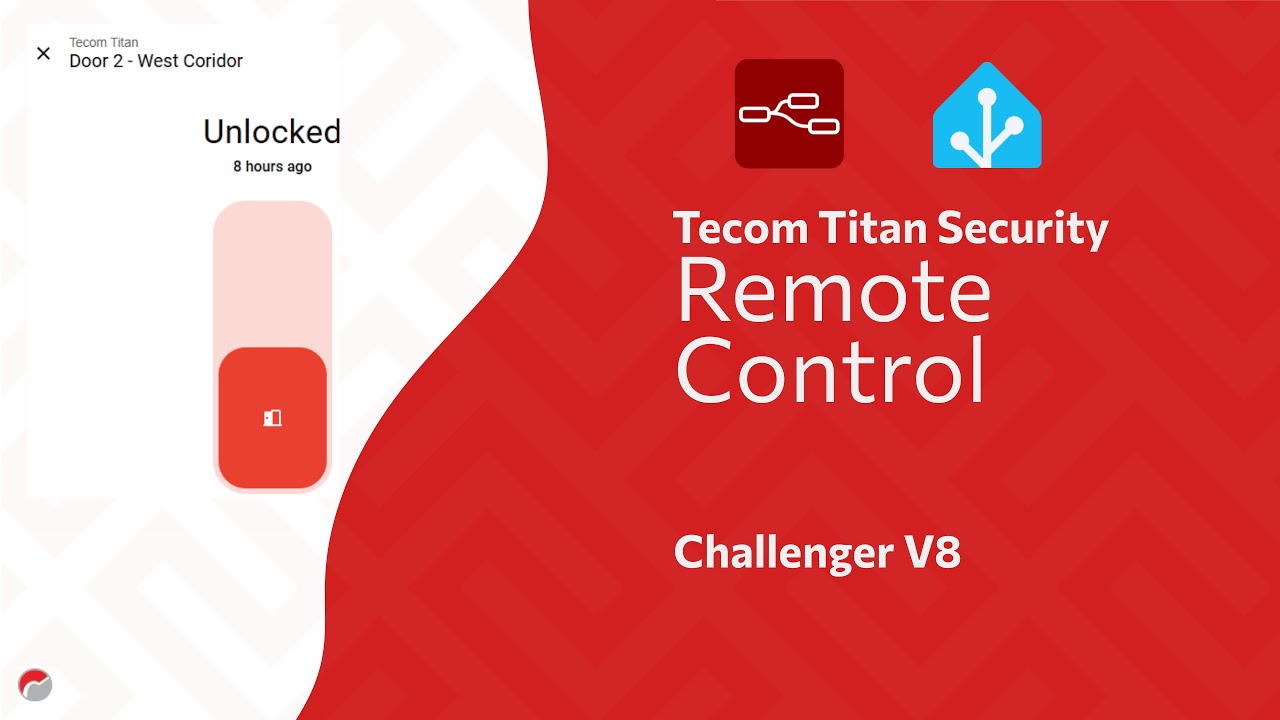
The Node-RED flows integrate with Home Assistant via MQTT using the ha-mqtt-lock nodes. Doors appear as lock entities that can be controlled from Home Assistant.
MQTT topics follow the pattern:
- State:
ha-mqtt/lock/Door_X/state - Command:
ha-mqtt/lock/Door_X/set
- The full protocol specification is not yet known
- The purpose of byte 1 in packets (varies between
0x70,0x60,0x40) is not fully understood - The second packet in command pairs (
5e738000...) is observed but its exact purpose is unclear - Only relay control, relay status polling and on-device time syncing have been reverse-engineered
node-red-contrib-buffer-parser- For parsing binary UDP datanode-red-contrib-ha-mqtt- For Home Assistant MQTT device integration
Titan Security Software Playlist
https://github.com/Shifteh-187/TECOM-CHALLENGER-PUSH
This is an unofficial, reverse-engineered protocol implementation. Use at your own risk. The author is not affiliated with Tecom or Aritech.