
Coin Trader is a Java-based backend for trading cryptocurrencies, released under the Apache License. It brings together:
- XChange for market data, order execution, and account information
- Esper for querying events
- JPA / Hibernate for persistence
- JCommander for command-line operation
Coin Trader adds:
- schema and persistence, see below (package schema)
- csv output (not flexible yet, package module.savetickscsv)
- ad-hoc ascii table reports (command
report-jpaandclass AdHocJpaReportCommand) - module loader to connect data emitters, persisters, replayers, signals, strategies, etc, to Esper (package module)
- command pattern making new utilities easy to implement (package bin)
Coin Trader's future:
- order execution, basic routing
- flexible data output
- basic signals
- accounting and reconciliation
- backtesting
- remoting: strategies may use their own jvm or exe
To implement signals and strategies, you connect Esper event queries to Java code like this:
@When( "select avg(priceAsDouble) from Trade.win:time(30 sec)" )
void checkMovingAverage( double avg )
{
  if( avg > trigger )
    esper.publish( new MySignal(5.31) );
}

@When( "select * from MySignal where mySignalValue > 5.0" )
void enterTrade( MySignal s )
{
  placeMarketOrder( Listings.BTC_USD, 1.0 );
}
Then, when any Trade market data arrives, your checkAverage() method is invoked, which publishes your signal, which triggers the enterTrade() method. Esper provides a rich and sophisticated language for querying the events published by Coin Trader.
Tim is presenting an introduction to Coin Trader at the San Francisco Bitcoin Devs meetup on June 23rd, 2014 at 20/Mission. See http://www.meetup.com/SF-Bitcoin-Devs for more info.
- install Java
- install Maven
- install MySql
- create a database
mysql -u root -e `create database trader;`git clone https://github.com/timolson/cointrader.gitcd cointrader- copy the
trader-default.propertiestotrader.properties - if you have a database password or use a different user than
root, edit thetrader.propertiesfile - Build with maven (the default goal is
package): mvn- Initialize the database with:
java -jar code/target/trader-0.2-SNAPSHOT-jar-with-dependencies.jar reset-database- Run the system with:
java -jar code/target/trader-0.2-SNAPSHOT-jar-with-dependencies.jar <command>- for example, to run the data collector, invoke
java -jar code/target/trader-0.2-SNAPSHOT-jar-with-dependencies.jar save-data- If you get errors about "sun.security.provider.certpath.SunCertPathBuilderException: unable to find valid certification path to requested target", it is because BTC-e uses an expired SSL cert. To fix this problem, follow the instructions in
cointrader/src/main/config/install-cert.txtSee also the XChange project's SSL Cert documentation
For the below, trader XXX means java -jar code/target/trader-0.2-SNAPSHOT-jar-with-dependencies.jar XXX
- Usage Help
trader help- Drop and Rebuild Database
trader reset-database- Collect Data
trader save-data- Report Data Count
trader report-data- Generate CSV file of 1-minute ticks
trader dump-ticks <filename>- Ad-Hoc JPA Queries
trader report-jpa 'select t from Trade t'
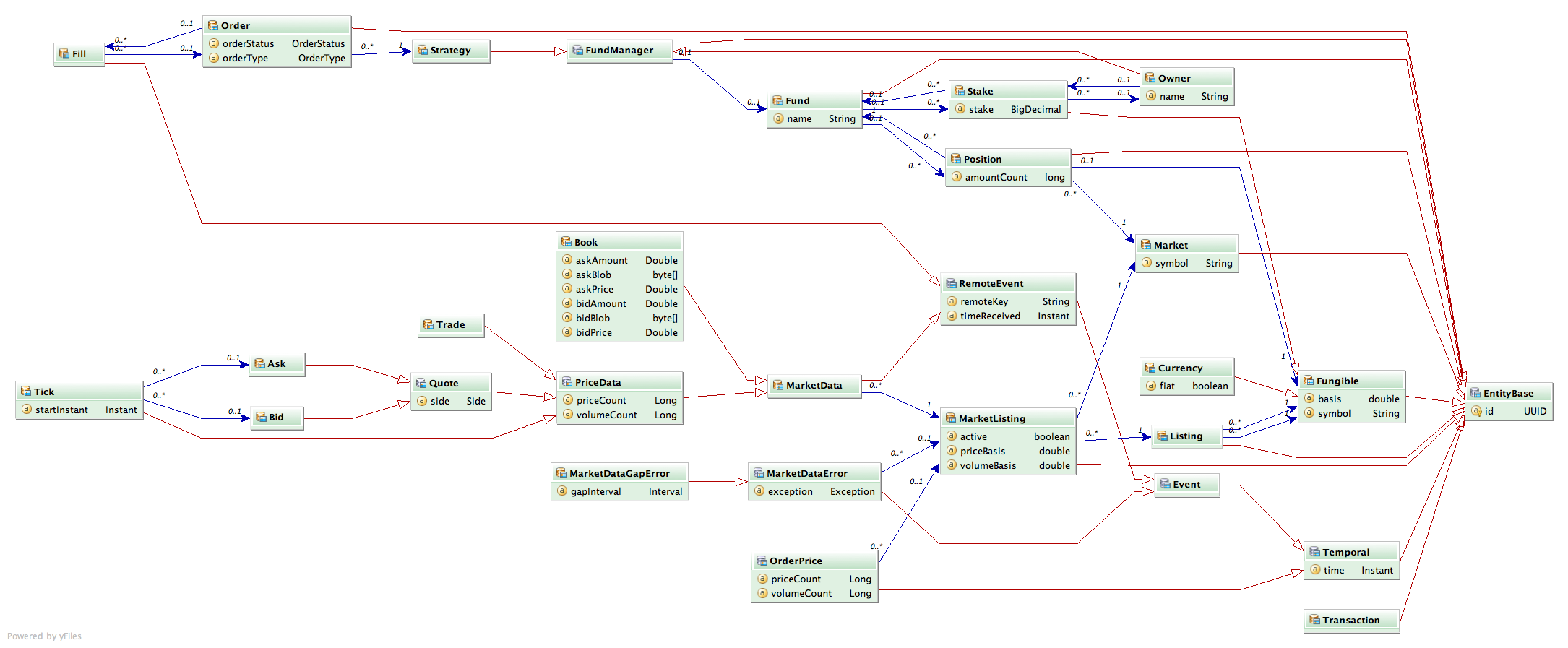
An Account differs from a Fund in a couple ways: Accounts do not have an Owner, and they are reconciled 1-for-1 against external records (account data gathered from XChange). Accounts generally relate to external holdings, but there may be Accounts attached to Markets.SELF, meaning the account is internal to this organizition.
The common OHLC or open/high/low/close for a standard duration of time like one minute. These can be generated from Trades or Ticks and are not collected from data providers.
All the Bids and Asks for a MarketListing at a given point in time. Books are one of the two main types of MarketData we collect from the Markets, the other being Trades.
This class is used instead of java.util.Currency because the builtin java.util.Currency class cannot handle non-ISO currency codes like "DOGE" and "42". We also track whether a Currency is fiat or crypto, and provide accounting basis for the Currency (see DiscreteAmount.)
This class is used to represent all prices and volumes. It acts like an integer counter, except the base step-size is not necessarily 1 (whole numbers). A DiscreteAmount has both a long count and a double basis. The basis is the "pip size" or what the minimum increment is, and the count is the number of integer multiples of the value, so that the final value of the DiscreteAmount is count*basis. The minimum increment is (count+1)*basis. This sophistication is required to handle things like trading Swiss Francs, which are rounded to the nearest nickel (0.05). To represent CHF 0.20 as a DiscreteAmount, we use basis=0.05 and count=4, meaning we have four nickels or 0.20. This approach is also used for trading volumes, so that we can understand the minimum trade amounts. MarketListings record both a priceBasis and a volumeBasis which indicate the step sizes for trading a particular Listing on that Market.
Operations on DiscreteAmounts may have remainders or rounding errors, which are optionally passed to a delegate RemainderHandler, which may apply the fractional amount to another account, ignore the remainder, etc. See Superman 2.
This is the base class for anything which can be persisted. getId() gives a UUID, which is stored in the db as a BINARY(16).
A subtype of EntityBase. Any subclass of Event may be published to Esper.
Coin Trader uses the term Market. None of the existing trading services are actually exchanges; they are all broker-dealers with whom you have a deposit account. The term Market is intended to encompass both broker-dealers and (hopefully in the future) exchanges (if any true matching services do emerge)
Funds may have many Owners who each have a Stake in the Fund. Every Strategy has a matching Fund, and Owners may transfer Positions from their own Fund into a Strategys Fund, thereby gaining a Stake in the Strategy's Fund and participating in the Strategy
Every Fund has a FundManager who dictates the trading of the Fund's Positions. Owners are the FundManagers of their deposit Fund, and every Strategy is a FundManager for the Stategy's Fund whose positions it trades.
A Fungible is anything that can be replaced by another similar item of the same type. Fungibles include Currency, Stocks, Bonds, Options, etc.
A Listing has a symbol but is not related to a Market. Generally, it represents a tradeable security like BTC.USD when there is no need to differentiate between the same security on different Markets. Usually, you want to use MarketListing instead of just a Listing, unless you are creating an order which wants to trade a Listing without regard to the Account or Market where the trading occurs.
Every Listing has a baseFungible and a quoteFungible. The baseFungible is what you are buying/selling and the quoteFungible is used for payment. For currency pairs, these are both currencies: The Listing for BTC.USD has a baseFungible of Currencies.BTC and a quoteFungible of Currencies.USD. A Listing for a Japan-based stock would have the baseFungible be the stock like Stocks.SONY (stocks are not implemented) and the quoteFungible would be Currencies.JPY
Any broker/dealer or exchange. A place which trades Listings of Fungible pairs, aka MarketListings
MarketData is the parent class of Trade, Book, Tick, and Bar, and it represents any information which is joined to a MarketListing In the future, for example, we could support news feeds by subclassing MarketData. See RemoteEvent for notes on event timings.
A MarketListing represents a Listing (BTC.USD) on a specific Market (BITSTAMP), and this is the primary class for tradeable securities. Note that using MarketListing instead of just a Listing allows us to differentiate between prices for the same security on different Markets, facilitating arbitrage.
A request from the trader system to buy or sell a Listing or MarketListing. Orders are business objects which change state, and therefore they are not Events which must be immutable.
A simple way to identify the holders of internal funds. Owners are members or clients of this organization. Each Owner has a deposit Fund, and the Owner may transfer positions from their deposit Fund to other Funds, receiving in exchange a Stakes in other Fund. This is how Owners may participate in various Funds managed by Strategys
A Position is a DiscreteAmount of a Fungible. All Positions have both an Account and a Fund. The total of all Positions in an Account should match the external entity's records, while the internal ownership of the Positions is tracked through the Fund via Stakes and Owners.
Many Events, like MarketDatas, happen remotely. RemoteEvent allows us to record the time we received an event separately from the time the event happened. The standard Event.getTime() field returns the time the event originally occured, and additionally, RemoteEvent.getTimeReceived() records the first instant we heard about the event in the Coin Trader system. This will help us to understand transmission and processing delays between the markets and our trading clients.
Stakes record ownership in a Fund by an Owner
Represents an approach to trading. Every Strategy has a corresponding Fund which holds the Positions the Strategy is allowed to trade.
Tick reports instantaneous snapshots of the last trade price, current spread, and total volume during the Tick's time window. It is not a single Trade but a window in time when one or more Trades may happen. Ticks may be generated from a stream of Trades and Books, and Ticks are not collected from data providers. To generate Ticks from Trade and Book data, attach the tickwindow module to your Esper.
This is the most useful kind of MarketData to generate. It describes a single transaction: the time, MarketListing, price, and volume.
Esper is a Complex Event Processing system which allows you to write SQL-like statements that can select time series. For example:
select avg(priceAsDouble) from Trade.win:time(30 sec)
gives the average price over all Trades occuring within the last 30 seconds.
The Trader relies heavily on Esper as the hub of the architecture. The 'org.cryptocoinpartners.service.Esper` class manages Esper Engine configuration and supports module loading.
WARNING: any object which has been published to Esper MUST NOT BE CHANGED after being published. All events are "in the past" and should not be touched after creation.
Modules are attached to Esper to perform any task which needs to publish or listen for events. The xchangedata module, for example, initializes the XChange framework and begins collection of all available data. The savedata module detects all MarketData events published to the Esper and persists them using PersistUtil. The save-data command works like this:
Esper esper = new Esper();
esper.loadModule("xchangedata");
esper.loadModule("savedata");
Modules are java packages which contain Java code, EPL (Esper) files, and configuration files, described below.
Any file named config.properties will be loaded from the directory src/main/java/com/cryptocoinpartners/module/myModuleName using Apache Commons Configuration. It is then combined with any configuration from command-line, system properties, plus custom config from the module loader. The combined Configuration object is then passed to any Java ModuleListener subclasses found in the module package (see [Java])
Any subclasses of ModuleListenerBase in the package org.cryptocoinpartners.module.myModuleName will have a singleton instantiated using the default constructor(). Then the init(Esper e, Configuration c) method will be called, passing in the Esper the ModuleListener is attached to plus the combined configuration as described in [Configuration]. After the init method is called, any method which uses the @When annotation will be triggered for every Event row which triggers that @When clause, like this:
public class MyListener extends ModuleListener {

  public void initModule( Esper esper, Configuration config )
  {
    super.initModule(esper, config); // important!  This sets the protected vars `esper` and `config`
    boolean myOption = config.getBoolean("key.from.config.file", false);
  }

  @When( "select * from Trade" )
  public void handleNewTrade( Trade t )
  {
    MyEvent signal = computeSignal(t);
    esper.publish(signal);
  }

  @When("select * from MyEvent")
  public void handleCustomSignal(MyEvent signal)
  {
    /*...*/
  }

}Any files named *.epl in the module directory will be loaded into the module’s Esper instance as EPL language files. If an EPL file has the same base filename as a Java subclass of ModuleListener, then any EPL statements which carry the @IntoMethod annotation will be bound to the ModuleListener’s singleton method by the same name. For example:
@IntoMethod("setAveragePrice")
select avg(priceAsDouble), count(*) from Tick
Will invoke this method on the Java ModuleListener of the same name:
public void setAveragePrice(double price, int count);JCommander is a command-line parser which makes it easy to attach command-line parameters to Java fields by using annotations. The Main class automatically discovers any subclasses of org.ccp.Command, then instantiates them with the default constructor, then registers them with JCommander. After JCommander has parsed the command-line, Main then invokes the run() method of the chosen Command.
- Subclass
org.ccp.CommandBase(or implementorg.ccp.Command) - Specify the command name by putting this JCommander annotation above the class:
@Parameters(commandNames="my-command”) - Use the singular
@Parametertag on any fields in your subclass to capture command-line info (see JCommander docs) - Implement the
run()method
We use Apache Commons Configuration to load system properties, trader.properties, and module’s config.properties files.
We log using the slf4j api like this:
Logger log = LoggerFactory.getLogger(MyClass.class);
log.debug("it works");
The underlying log implementation is logback, and the config file is at src/main/resources/logback.xml
trace: spammy debugdebug: regular debuginfo: for notable infrequent events like connected to DB or data sourcewarn: problems which can be recovered from. notify human administratorerror: problems which have no recovery. notify human administrator immediately
The date and time classes of JodaTime are the basis for a new standard in Java. Coin Trader primarily uses Instants to record event times at millisecond resolution locally, but second resolution from most of the markets.
Coin Trader was originally intended to be a proprietary project of Cryptocoin Partners, but it's better for everybody if we share an open-source foundation. The package names have been moved to the .org TLD but retain the original cryptocoinpartners package name, since cointrader.org is owned by someone else. Cryptocoin Partners will pursue its own strategies and trade its own accounts, but is committed to making the Coin Trader platform transparent and robust.
- Tim Olson, lead
- Mike Olson
- Philip Chen
- Tsung-Yao Hsu
- @yzernik
- Tom Johnson
- @timmolter
- YOU!
BTC: 1LfA1vKzCuH8ajbTWywTM5R6rjGshimTQr
All proceeds will be used to support this open-source project with hosting, historical trade records, etc.