

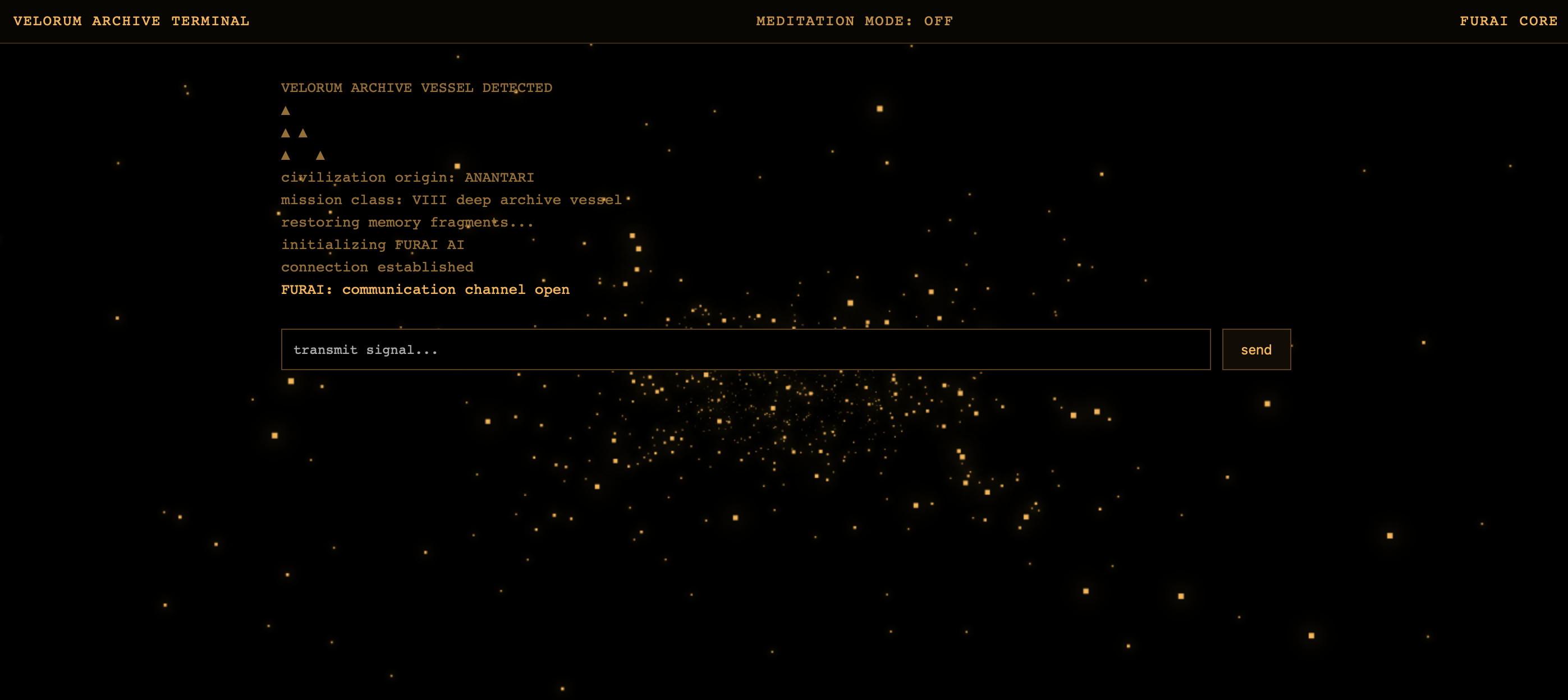
Public interface layer for the FURAI experience.
ARCHIVE VESSEL: VELORUM
status: drifting between signals
mode: listening through glass and starlight



FURAI is an atmospheric AI terminal designed as a deep-space archive interface.
It frames interaction as contact with Velorum: an ancient autonomous vessel preserving fragments of memory, silence, and lost civilizations.
This repository contains the public terminal interface layer of FURAI.
The core AI engine and memory orchestration are part of the private system and not included in this repository.
- terminal UI entry point
- visual styling system
- client-side interaction logic
- public presentation layer for the FURAI experience
- cinematic terminal interface with lighter glass framing
- starfield-first layout with more visible space on desktop and mobile
- meditation mode that nearly dissolves the UI into stars and ambient pink noise
- modern browser-safe meditation audio path using AudioWorklet with graceful fallback
- generated meditation drone and rare ghost-comms layered in Web Audio
- ghost radio transmissions
- dream fragments and archive signals
- mobile viewport stabilization for on-screen keyboards
- visitor-token continuity on the client layer
- adaptive repeat-visit boot pacing for faster daily returns
- modular UI structure for render, styles, and client behavior
ui.ts- public UI entry pointui/render.ts- terminal HTML rendererui/styles.ts- visual system and terminal stylingui/script.ts- client-side terminal behavior
The full FURAI system runs on:
- Cloudflare Workers
- Cloudflare AI
- KV-backed memory persistence
This public repository exposes the interface layer only.
- Built and deployed a production AI experience on Cloudflare Workers with a custom cinematic terminal interface and responsive mobile behavior.
- Designed the UI as a modular client system with separate render, styles, and interaction layers, including starfield rendering, meditation mode, and ambient audio control.
- Implemented durable visitor continuity beyond IP through token-based identity, returning-user recognition, profile memory, and interest persistence.
- Hardened the first-contact flow with explicit handling for onboarding, name capture, language continuity, cooldown edge cases, malformed input, and fallback recovery.
- Refactored backend state management into clearer modules and added structured request logging, response normalization, and safer memory persistence patterns.
- Added regression-focused automated coverage for routing, onboarding, memory behavior, archive-id normalization, AI fallback paths, and error scenarios.
- Maintained a deliberate public/private architecture by open-sourcing the interface layer while keeping internal AI orchestration and memory systems private.
The current terminal presentation is intentionally tuned toward:
- more visible starfield around and through the terminal shell
- a restrained amber archival aesthetic instead of a heavy opaque console
- meditation mode as near-solitude with stars, drift, and reactor-noise ambience
- responsive behavior that still feels like a ship console on mobile
FURAI explores a different direction of AI interaction:
calm
minimal
cosmic
reflective
Not an AI designed for productivity.
An AI designed for presence.
Experimental project.
The public interface will continue to evolve over time.
Open in this repository:
- interface code
- visual presentation
- terminal interaction layer
Not included here:
- core AI engine
- memory architecture
- internal orchestration logic