TypeScript/Node.js multi-agent orchestrator — shared state, guardrails, budgets, and cross-framework coordination











Network-AI is a TypeScript/Node.js multi-agent orchestrator that adds coordination, guardrails, and governance to any AI agent stack.
- Shared blackboard with locking — atomic
propose → validate → commitprevents race conditions and split-brain failures across parallel agents - Guardrails and budgets — FSM governance, per-agent token ceilings, HMAC audit trails, and permission gating
- 12 framework adapters — LangChain, AutoGen, CrewAI, OpenAI Assistants, LlamaIndex, Semantic Kernel, and more in one orchestrator — no glue code, no lock-in
Use Network-AI as:
- A TypeScript/Node.js library —
import { createSwarmOrchestrator } from 'network-ai' - An MCP server —
npx network-ai-server --port 3001 - An OpenClaw skill —
clawhub install network-ai
5-minute quickstart → | Architecture → | All adapters → | Benchmarks →
| Problem | How Network-AI solves it |
|---|---|
| Race conditions in parallel agents | Atomic blackboard: propose → validate → commit with file-system mutex |
| Agent overspend / runaway costs | FederatedBudget — hard per-agent token ceilings with live spend tracking |
| No visibility into what agents did | HMAC-signed audit log on every write, permission grant, and FSM transition |
| Locked into one AI framework | 12 adapters — mix LangChain + AutoGen + CrewAI + custom in one swarm |
| Agents escalating beyond their scope | AuthGuardian — scoped permission tokens required before sensitive operations |
%%{init: {'theme': 'base', 'themeVariables': {'primaryColor': '#1e293b', 'primaryTextColor': '#e2e8f0', 'primaryBorderColor': '#475569', 'lineColor': '#94a3b8', 'clusterBkg': '#0f172a', 'clusterBorder': '#334155', 'edgeLabelBackground': '#1e293b', 'edgeLabelColor': '#cbd5e1', 'titleColor': '#e2e8f0'}}}%%
flowchart TD
    classDef app        fill:#1e3a5f,stroke:#3b82f6,color:#bfdbfe,font-weight:bold
    classDef security   fill:#451a03,stroke:#d97706,color:#fde68a
    classDef routing    fill:#14532d,stroke:#16a34a,color:#bbf7d0
    classDef quality    fill:#3b0764,stroke:#9333ea,color:#e9d5ff
    classDef blackboard fill:#0c4a6e,stroke:#0284c7,color:#bae6fd
    classDef adapters   fill:#064e3b,stroke:#059669,color:#a7f3d0
    classDef audit      fill:#1e293b,stroke:#475569,color:#94a3b8

    App["Your Application"]:::app
    App -->|"createSwarmOrchestrator()"| SO

    subgraph SO["SwarmOrchestrator"]
        AG["AuthGuardian\n(permission gating)"]:::security
        AR["AdapterRegistry\n(route tasks to frameworks)"]:::routing
        QG["QualityGateAgent\n(validate blackboard writes)"]:::quality
        BB["SharedBlackboard\n(shared agent state)\npropose → validate → commit\nfilesystem mutex"]:::blackboard
        AD["Adapters — plug any framework in, swap freely\nLangChain · AutoGen · CrewAI · MCP · LlamaIndex · …"]:::adapters

        AG -->|"grant / deny"| AR
        AR -->|"tasks dispatched"| AD
        AD -->|"writes results"| BB
        QG -->|"validates"| BB
    end

    SO --> AUDIT["data/audit_log.jsonl"]:::audit
FederatedBudgetis a standalone export — instantiate it separately and optionally wire it to a blackboard backend for cross-node token budget enforcement.
→ Full architecture, FSM journey, and handoff protocol
npm install network-aiNo native dependencies, no build step. Adapters are dependency-free (BYOC — bring your own client).
The real differentiator is coordination. Here is what no single-framework solution handles: two agents writing to the same resource concurrently, atomically, without corrupting each other.
import { LockedBlackboard, CustomAdapter, createSwarmOrchestrator } from 'network-ai';

const board   = new LockedBlackboard('.');
const adapter = new CustomAdapter();

// Agent 1: writes its analysis result atomically
adapter.registerHandler('analyst', async () => {
  const id = board.propose('report:status', { phase: 'analysis', complete: true }, 'analyst');
  board.validate(id, 'analyst');
  board.commit(id);                           // file-system mutex — no race condition possible
  return { result: 'analysis written' };
});

// Agent 2: runs concurrently, writes to its own key safely
adapter.registerHandler('reviewer', async () => {
  const id = board.propose('report:review', { approved: true }, 'reviewer');
  board.validate(id, 'reviewer');
  board.commit(id);
  const analysis = board.read('report:status');
  return { result: `reviewed phase=${analysis?.phase}` };
});

createSwarmOrchestrator({ adapters: [{ adapter }] });

// Both fire concurrently — mutex guarantees no write is ever lost
const [, ] = await Promise.all([
  adapter.executeAgent('analyst',  { action: 'run', params: {} }, { agentId: 'analyst' }),
  adapter.executeAgent('reviewer', { action: 'run', params: {} }, { agentId: 'reviewer' }),
]);

console.log(board.read('report:status'));   // { phase: 'analysis', complete: true }
console.log(board.read('report:review'));   // { approved: true }
Add budgets, permissions, and cross-framework agents with the same pattern. → QUICKSTART.md
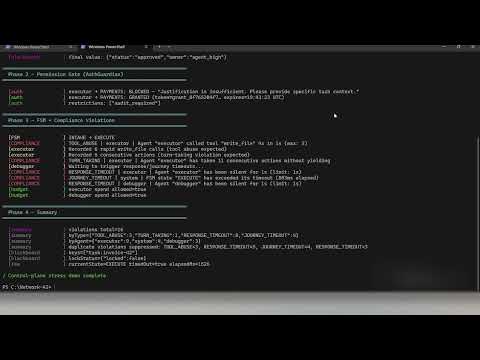
Runs in ~3 seconds. Proves the coordination primitives without any LLM calls.
npm run demo -- --08What it shows: atomic blackboard locking, priority preemption (priority-3 wins over priority-0 on same key), AuthGuardian permission gate (blocked → justified → granted with token), FSM hard-stop at 700 ms, live compliance violation capture (TOOL_ABUSE, TURN_TAKING, RESPONSE_TIMEOUT, JOURNEY_TIMEOUT), and FederatedBudget tracking — all without a single API call.
8-agent AI pipeline (requires OPENAI_API_KEY — builds a Payment Processing Service end-to-end):
npm run demo -- --07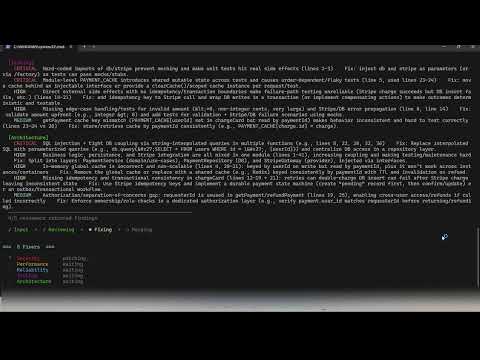
12 frameworks, zero adapter dependencies. You bring your own SDK objects.
| Adapter | Framework | Register method |
|---|---|---|
CustomAdapter |
Any function or HTTP endpoint | registerHandler(name, fn) |
LangChainAdapter |
LangChain | registerRunnable(name, runnable) |
AutoGenAdapter |
AutoGen / AG2 | registerAgent(name, agent) |
CrewAIAdapter |
CrewAI | registerAgent or registerCrew |
MCPAdapter |
Model Context Protocol | registerTool(name, handler) |
LlamaIndexAdapter |
LlamaIndex | registerQueryEngine(), registerChatEngine() |
SemanticKernelAdapter |
Microsoft Semantic Kernel | registerKernel(), registerFunction() |
OpenAIAssistantsAdapter |
OpenAI Assistants | registerAssistant(name, config) |
HaystackAdapter |
deepset Haystack | registerPipeline(), registerAgent() |
DSPyAdapter |
Stanford DSPy | registerModule(), registerProgram() |
AgnoAdapter |
Agno (formerly Phidata) | registerAgent(), registerTeam() |
OpenClawAdapter |
OpenClaw | registerSkill(name, skillRef) |
Extend BaseAdapter to add your own in minutes. See references/adapter-system.md.
Network-AI is the coordination layer you add on top of your existing stack. Keep your LangChain chains, CrewAI crews, and AutoGen agents — and add shared state, governance, and budgets around them.
| Capability | Network-AI | LangGraph | CrewAI | AutoGen |
|---|---|---|---|---|
| Cross-framework agents in one swarm | ✅ 12 built-in adapters | |||
| Atomic shared state (conflict-safe) | ✅ propose → validate → commit mutex |
|||
| Hard token ceiling per agent | ✅ FederatedBudget (first-class API) |
|||
| Permission gating before sensitive ops | ✅ AuthGuardian (built-in) |
|||
| Append-only audit log | ✅ plain JSONL (data/audit_log.jsonl) |
|||
| Encryption at rest | ✅ AES-256-GCM (TypeScript layer) | |||
| Language | TypeScript / Node.js | Python | Python | Python |
npm run test:all          # All suites in sequence
npm test                  # Core orchestrator
npm run test:security     # Security module
npm run test:adapters     # All 12 adapters
npm run test:priority     # Priority & preemption
1,184 passing assertions across 15 test suites (verified by counting assert() / pass() calls in each file):
| Suite | Assertions | Covers |
|---|---|---|
test-standalone.ts |
83 | Blackboard, auth, integration, persistence, parallelisation, quality gate |
test-adapters.ts |
142 | All 12 adapters, registry routing, integration, edge cases |
test-phase4.ts |
133 | FSM, compliance monitor, adapter integration |
test-phase5d.ts |
119 | Pluggable backend |
test-phase5f.ts |
113 | Phase 5f extended |
test-phase5g.ts |
106 | Phase 5g extended |
test-phase6.ts |
122 | Latest feature coverage |
test-phase5c.ts |
74 | Named multi-blackboard |
test-phase5e.ts |
88 | Phase 5e |
test-phase5b.ts |
56 | Pluggable backend part 2 |
test-priority.ts |
65 | Priority preemption, conflict resolution, backward compat |
test-security.ts |
35 | Tokens, sanitization, rate limiting, encryption, audit |
test-phase5.ts |
24 | Named multi-blackboard base |
test.ts |
24 | Full integration |
test-phase4.ts (stubs) |
4 | FSM stub coverage |
| Doc | Contents |
|---|---|
| QUICKSTART.md | Installation, first run, PowerShell guide, Python scripts CLI |
| ARCHITECTURE.md | Race condition problem, FSM design, handoff protocol, project structure |
| BENCHMARKS.md | Provider performance, rate limits, local GPU, max_completion_tokens guide |
| SECURITY.md | Security module, permission system, trust levels, audit trail |
| ENTERPRISE.md | Evaluation checklist, stability policy, security summary, integration entry points |
| AUDIT_LOG_SCHEMA.md | Audit log field reference, all event types, scoring formula |
| ADOPTERS.md | Known adopters — open a PR to add yourself |
| INTEGRATION_GUIDE.md | End-to-end integration walkthrough |
| references/adapter-system.md | Adapter architecture, writing custom adapters |
| references/auth-guardian.md | Permission scoring, resource types |
| references/trust-levels.md | Trust level configuration |
- Fork → feature branch →
npm run test:all→ pull request - Bugs and feature requests via Issues
- If Network-AI saves you time, a ⭐ helps others find it

MIT License — LICENSE · CHANGELOG · CONTRIBUTING ·

Keywords
multi-agent · agent orchestration · AI agents · agentic AI · agentic workflow · TypeScript · Node.js · LangGraph · CrewAI · AutoGen · MCP · model-context-protocol · LlamaIndex · Semantic Kernel · OpenAI Assistants · Haystack · DSPy · Agno · OpenClaw · ClawHub · shared state · blackboard pattern · atomic commits · guardrails · token budgets · permission gating · audit trail · agent coordination · agent handoffs · governance · cost-awareness