Alexandria National University
Data Science & AI Department
Student Name and ID:
- Omar Hany Ramadan Badr
- ID 2405728
This report provides a comprehensive analysis of the two Connect Four AI algorithms implemented in the provided codebase: Minimax (without pruning) and Minimax with Alpha-Beta Pruning. The analysis includes a detailed look at the underlying data structures and algorithms, a comparison of their performance across various search depths (
The core data structure for the game state is managed by the Board class (board.py).
| Data Structure | Purpose | Implementation Detail |
|---|---|---|
| Game Board | Stores the state of the 6x7 Connect Four grid. | A 2D Python list (self.grid) where each element is an integer: 0 (EMPTY), 1 (HUMAN), or 2 (AI). |
| Transposition Table (TT) | Caches the results of previously computed game states to avoid redundant calculations. | A Python dictionary (self.transposition) within the Minimax class. The key is a tuple representation of the board state (board.as_tuple()), the remaining search depth, and whether the current node is a maximizing node. |
The AI decision-making is handled by the Minimax class (minimax.py), which implements two distinct search algorithms:
-
Minimax (Without Pruning): A standard recursive implementation of the Minimax algorithm that explores every node in the search tree up to the specified depth
$K$ . -
Minimax with Alpha-Beta Pruning: An optimized version of Minimax that uses
$\alpha$ (alpha) and$\beta$ (beta) cutoffs to eliminate branches of the search tree that cannot possibly influence the final decision.
Both implementations share several key features:
-
Iterative Deepening (ID): The
find_best_movemethods use Iterative Deepening, starting the search from depth 1 and increasing the depth until the maximum depth$K$ is reached or a time limit is exceeded. -
Move Ordering: Moves are ordered based on a quick, shallow evaluation before the main search begins. This is a crucial optimization for Alpha-Beta Pruning, as evaluating better moves first increases the likelihood of early cutoffs.
-
Transposition Table (TT): Both algorithms utilize a Transposition Table to store and retrieve previously calculated scores for identical board states, further reducing redundant computation.
The evaluation function, or heuristic, is defined in heuristic.py. It calculates a score for a given board state from the AI's perspective (maximizing player). The heuristic is a weighted sum of various features:
| Feature | Weight | Description |
|---|---|---|
| Four-in-a-row | A winning position for the AI. | |
| Open Three | Three AI pieces in a line with both ends open. | |
| Open Two | Two AI pieces in a line with both ends open. | |
| Opponent Open Three | A critical threat (three opponent pieces in a line with one open end) is penalized more heavily than a simple AI Open Three is rewarded, encouraging defensive play. | |
| Center Control | Rewards pieces placed in the center column, which is strategically valuable in Connect Four. |
The following assumptions and details were noted from the codebase and experimental setup:
-
Definition of K:
$K$ represents the maximum search depth for the Minimax algorithm. Due to the use of Iterative Deepening, the algorithm searches all depths from 1 up to$K$ . -
Time Limit: The comparison script was run without a time limit to ensure a complete search up to depth
$K$ for accurate node count comparison. -
Test Position: All comparison data and sample runs were generated from a fixed, mid-game test position (as defined in
main.py'scompare_algorithms_with_treesfunction):. . . . . . . . . . . . . . . . . . . . . . . . . . . . . . . O . . . . . . X X . . 0 1 2 3 4 5 6(AI is 'O', Human is 'X'. AI is the maximizing player and is to move next.)
A sample run was executed on the test position with a search depth of
| Algorithm | Best Move (Column) | Evaluation Value | Time Taken (s) | Nodes Expanded |
|---|---|---|---|---|
| Minimax (No Pruning) | 2 | 13 | 0.093 | 856 |
| Alpha-Beta Pruning | 2 | 13 | 0.072 | 521 |
Both algorithms correctly identified the same best move (column 2) with the same evaluation value (13), confirming the correctness of the Alpha-Beta implementation.
The Minimax tree explores all branches, as indicated by the absence of PRUNED nodes.
ENTER | col=None | val=MAX (a=N/A, b=N/A)
├── ENTER | col=4 | val=MIN (a=N/A, b=N/A)
│ ├── ENTER | col=3 | val=MAX (a=N/A, b=N/A)
│ │ ├── LEAF | col=4 | val=63 (a=N/A, b=N/A)
│ │ ├── child | col=4 | val=63 (a=N/A, b=N/A)
│ │ ├── LEAF | col=2 | val=43 (a=N/A, b=N/A)
│ │ ├── child | col=2 | val=43 (a=N/A, b=N/A)
... (continues to explore all 7 branches)
│ ├── EXIT | col=3 | val=63 (a=N/A, b=N/A)
│ ├── child | col=3 | val=63 (a=N/A, b=N/A)
│ ├── ENTER | col=4 | val=MAX (a=N/A, b=N/A)
... (continues to explore all 7 branches)
│ ├── EXIT | col=4 | val=66 (a=N/A, b=N/A)
...
The Alpha-Beta tree shows cutoffs, significantly reducing the number of nodes explored. In the snippet below, a pruning event occurs at line 23, where the
ENTER | col=None | val=MAX (a=-inf, b=inf)
├── ENTER | col=4 | val=MIN (a=-inf, b=inf)
│ ├── ENTER | col=3 | val=MAX (a=-inf, b=inf)
... (explores 7 branches)
│ ├── EXIT | col=3 | val=63 (a=63, b=inf)
│ ├── child | col=3 | val=63 (a=-inf, b=inf)
│ ├── ENTER | col=4 | val=MAX (a=-inf, b=63)
│ │ ├── LEAF | col=3 | val=66 (a=-inf, b=63)
│ │ ├── child | col=3 | val=66 (a=-inf, b=63)
│ │ ├── PRUNED | a=66 | b=63  <-- Alpha-Beta Cutoff
│ ├── EXIT | col=4 | val=66 (a=66, b=63)
...
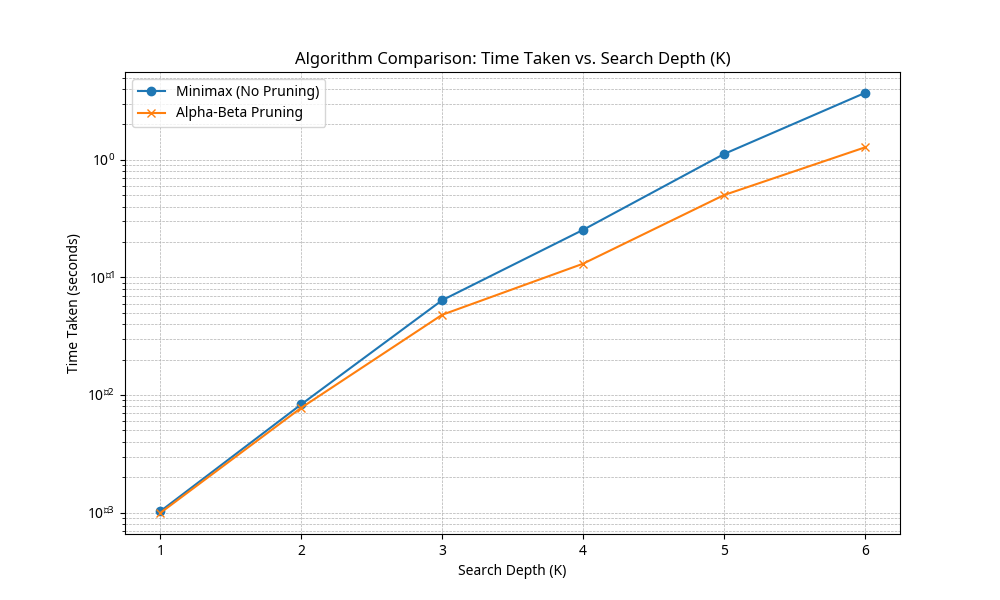
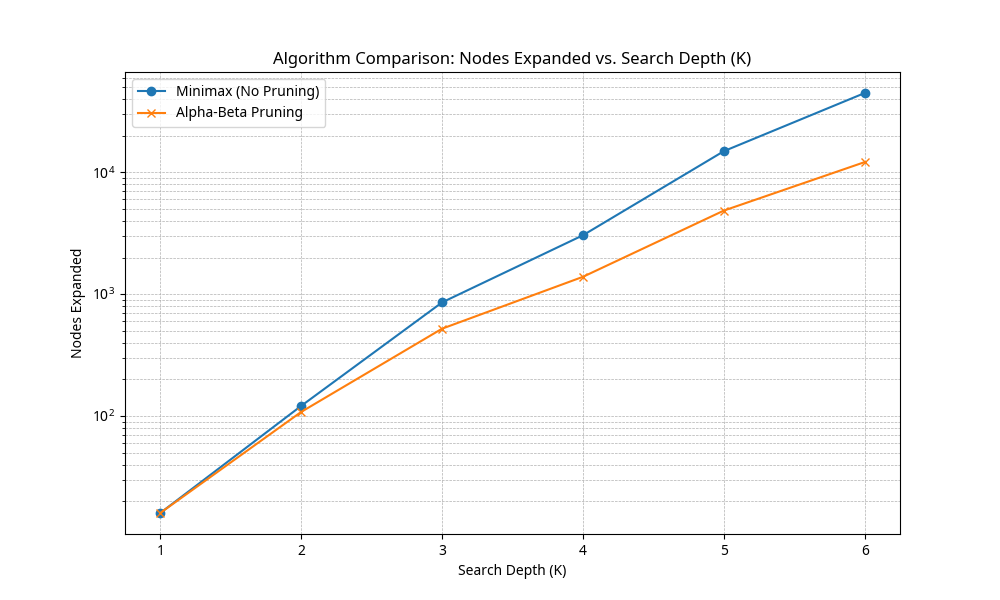
The two algorithms were compared across search depths
| K (Depth) | Algorithm | Time Taken (s) | Nodes Expanded | Node Reduction (%) | Speedup (x) |
|---|---|---|---|---|---|
| 1 | Minimax | 0.0010 | 16 | 0.00 | 1.03 |
| 1 | Alpha-Beta | 0.0010 | 16 | - | - |
| 2 | Minimax | 0.0083 | 121 | 10.74 | 1.07 |
| 2 | Alpha-Beta | 0.0078 | 108 | - | - |
| 3 | Minimax | 0.0639 | 856 | 39.14 | 1.33 |
| 3 | Alpha-Beta | 0.0481 | 521 | - | - |
| 4 | Minimax | 0.2535 | 3046 | 54.40 | 1.94 |
| 4 | Alpha-Beta | 0.1307 | 1389 | - | - |
| 5 | Minimax | 1.1192 | 14924 | 67.46 | 2.23 |
| 5 | Alpha-Beta | 0.5010 | 4856 | - | - |
| 6 | Minimax | 3.6996 | 44803 | 72.90 | 2.90 |
| 6 | Alpha-Beta | 1.2743 | 12146 | - | - |
The following charts illustrate the exponential growth of both time and nodes expanded as the search depth
The experimental results confirm the theoretical advantage of Alpha-Beta Pruning:
-
Nodes Expanded: The percentage of nodes pruned increases dramatically with depth. At
$K=6$ , Alpha-Beta Pruning reduced the number of nodes expanded by 72.90% compared to the unpruned Minimax algorithm. This is the primary source of the performance gain. -
Time Taken: The time taken for the search is directly proportional to the number of nodes expanded. At
$K=6$ , Alpha-Beta Pruning resulted in a 2.90x speedup over the standard Minimax algorithm. This speedup is crucial for increasing the effective search depth within a fixed time limit, which is essential for a stronger AI player.
The comparison of the two algorithms across a range of search depths (
The implemented Connect Four AI successfully utilizes the Minimax algorithm, enhanced by Alpha-Beta Pruning, Iterative Deepening, Move Ordering, and a Transposition Table. The experimental comparison demonstrates that Alpha-Beta Pruning is highly effective, reducing the number of nodes expanded by over 70% at