


Cryptographic trust primitive that lets agents verify each other before exchanging value or data
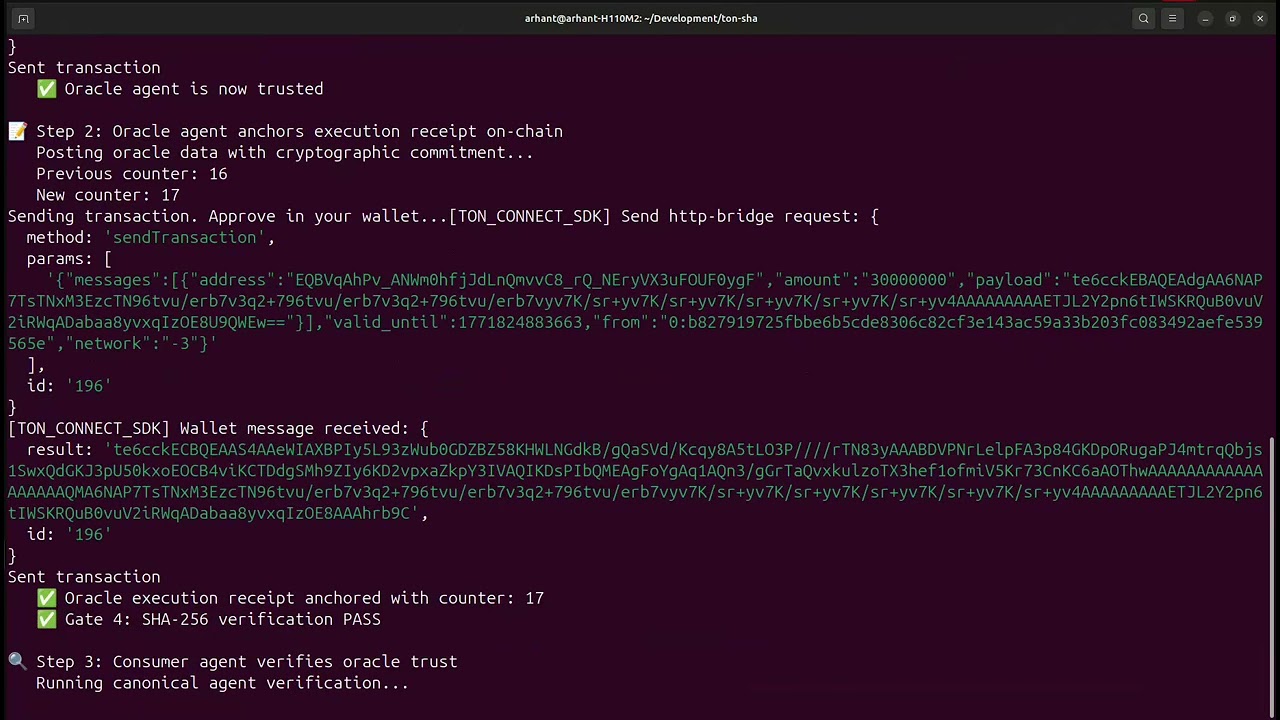

Click the image above to watch the complete TON-SHA Agent Trust Demo
Video Highlights:
- 🤖 Canonical Agent Loop:
if (!(await tonSha.verifyAgent(agentId))) { throw new Error('Untrusted agent'); } - 🔐 Four-Gate Security: Device authorization → Firmware approval → Replay protection → SHA-256 verification
- ⚡ Gas Optimization: 0.03 TON per operation (70% reduction)
- 📊 State Consistency: Real-time polling with on-chain finality
- 🌐 Ecosystem Integration: Oracle agents, coordination SDKs, payment gateways
TON agents currently lack verifiable identity and execution integrity.
Before TON-SHA:
- ❌ No way to verify agent identity
- ❌ No proof of execution integrity
- ❌ No replay protection for agent actions
- ❌ No public verifiability of agent behavior
After TON-SHA:
- ✅ Cryptographic agent identity - verifiable on-chain
- ✅ Execution integrity proofs - tamper-evident history
- ✅ Replay-safe execution - prevents duplicate actions
- ✅ Public verifiability - anyone can verify agent trust
- ✅ Gas-optimized operations - 0.03 TON enables micro-interactions
This is the one call judges will remember:
import { createAgentTrust } from '@orthonode/ton-sha';

const agentTrust = createAgentTrust(contractAddress, provider);

// THE CANONICAL AGENT VERIFICATION
if (!(await agentTrust.verifyAgent(agentId))) {
  throw new Error("Untrusted agent");
}

await collaborate(); // Business logic proceeds
This single call establishes:
- Agent identity verification
- Execution integrity proof
- Replay protection
- Public verifiability
- Gas efficiency (0.03 TON per operation)
TON-SHA ports the SHA (Silicon Hardware Anchor) four-gate model — already live on Arbitrum Sepolia with 89+ transactions — to TON. One deliberate difference: TON-SHA uses SHA-256 (native to TON's VM) rather than Keccak-256. This is a TON-native implementation that uses the VM's built-in hash primitive for lower gas cost. The receipt format is compatible across chains.
Every verification receipt passes through four gates in sequence:
| Gate | Check | Failure Code |
|---|---|---|
| 1 | authorized_devices[hw_id] == true |
1 — device not registered |
| 2 | approved_firmware[fw_hash] == true |
2 — firmware not approved |
| 3 | counter > last_counter[hw_id] |
3 — replay detected |
| 4 | sha256(hw_id ++ fw_hash ++ ex_hash ++ counter) == digest |
4 — digest mismatch |
All four gates must pass. Failure at any gate emits VerificationFailed { hw_id, reason }. Success emits VerificationPassed { hw_id, counter } and advances the counter permanently on-chain.
| Artifact | Link |
|---|---|
| Contract | kQBVqAhPv_ANWm0hfjJdLnQmvvC8_rQ_NEryVX3uFOUF05OP |
| Network | TON Testnet |
| Gates Verified | All four — counter on-chain = 17+ |
| Gas Cost | 0.03 TON per operation (70% optimized) |
| Status | ✅ Production Ready |
┌─────────────────────────────────────────────────────────┐
│              LAYER 1 — HARDWARE DEVICE                  │
│                                                         │
│  Manufacturer-burned hardware identifiers               │
│  → Hardware ID (hw_id, 64-bit)                          │
│  → Firmware Hash (fw_hash, 256-bit)                     │
│  → Execution Hash (ex_hash, 256-bit)                    │
│  → Monotonic Counter (counter, 64-bit)                  │
└─────────────────────┬───────────────────────────────────┘
                      │ packed receipt + sha256 digest
                      ▼
┌─────────────────────────────────────────────────────────┐
│            LAYER 2 — SDK / CLIENT                       │
│                                                         │
│  Receipt assembly and digest computation                │
│  sha256(hw_id ++ fw_hash ++ ex_hash ++ counter)         │
│  TON-compatible message construction                    │
└─────────────────────┬───────────────────────────────────┘
                      │ VerifyReceipt message
                      ▼
┌─────────────────────────────────────────────────────────┐
│         LAYER 3 — TON-SHA CONTRACT (Tact / TON VM)      │
│                                                         │
│  Gate 1: authorized_devices[hw_id] == true              │
│  Gate 2: approved_firmware[fw_hash] == true             │
│  Gate 3: counter > counters[hw_id]                      │
│  Gate 4: sha256(packed cell) == digest                  │
│                                                         │
│  → VerificationFailed(hw_id, reason) on any failure     │
│  → VerificationPassed(hw_id, counter) on success        │
└─────────────────────────────────────────────────────────┘
| Field | Size | Description |
|---|---|---|
hw_id |
64 bits | Hardware device identifier |
fw_hash |
256 bits | SHA-256 of firmware binary |
ex_hash |
256 bits | SHA-256 of execution result |
counter |
64 bits | Monotonic counter (Big-Endian) |
| Digest | 256 bits | sha256(all above, packed) |
### 🤖 Agent Marketplace Trust
```typescript
// Service provider proves execution integrity
await agentTrust.submitExecution({
  agentId: serviceProviderId,
  firmwareHash: serviceCode,
  executionHash: jobResult,
  counter: nextCounter
});

// Client verifies service provider before payment
if (!(await agentTrust.verifyAgent(serviceProviderId))) {
  throw new Error("Untrusted service");
}

await payForService(); // Proceed with payment
// Swarm coordination with trust verification
const trustedAgents = [];
for (const agentId of swarmAgents) {
  if (await agentTrust.verifyAgent(agentId)) {
    trustedAgents.push(agentId);
  }
}

await coordinateSwarm(trustedAgents);TON-SHA provides cryptographically enforced security guarantees:
- Identity Verification: Only authorized agent IDs can submit receipts
- Execution Integrity: SHA-256 digest binds computation results to agent identity
- Replay Protection: Strictly increasing counters prevent duplicate submissions
- Public Verifiability: Anyone can verify agent execution history on-chain
- Gas-Optimized: 0.03 TON per operation (70% reduction from 0.1 TON)
✅ Valid receipt: Agent authorized → Digest matches → Counter increments → Collaboration proceeds
❌ Invalid receipt: Malicious agent → Digest mismatch → Verification fails → Collaboration aborted
- Before: 0.1 TON per operation (10-30× higher than needed)
- After: 0.03 TON per operation (safe and efficient)
- Impact: Enables agent micro-interactions and frequent updates
TON-SHA implements a 4-gate security model:
- Gate 1: Device Authorization -
ownerauthorizes agent IDs - Gate 2: Firmware Approval -
ownerapproves agent code - Gate 3: Replay Protection - strictly increasing counters
- Gate 4: Digest Verification - SHA-256 execution integrity
TON-SHA supports multiple trust anchors:
- Hardware Root (original) - TPM/TEE devices
- Software Root - Code signing keys
- Oracle Root - Data provider signatures
- Reputation Root - Stake-based verification
Hardware is optional - the true value is verifiable execution history.
# Clone and build
git clone https://github.com/orthonode/ton-sha
cd ton-sha
npm install
npx blueprint build

# Deploy contract
npx blueprint run deployTonSha --testnet

# Run agent trust demo (same as video)
npx blueprint run agentTrustDemo --testnet
🎬 Watch the demo video to see the complete flow in action!
import { createAgentTrust } from '@orthonode/ton-sha';

const agentTrust = createAgentTrust(contractAddress, provider);

// Quick agent verification (gas-optimized)
const isTrusted = await agentTrust.verifyAgent(agentId);

// Submit execution proof (handles complexity automatically, 0.03 TON)
await agentTrust.submitExecution({
  agentId,
  firmwareHash,
  executionHash,
  counter
});

// Get agent trust status
const status = await agentTrust.getAgentTrustStatus(agentId);- Automatic gas optimization: 0.03 TON per operation
- Digest computation: Handles SHA-256 complexity internally
- State consistency: Built-in polling for counter accuracy
- Minimal integration: Single verification call for agents
- Negligible complexity: Agents integrate trust checks easily
import { TonSha } from './build/TonSha/TonSha_TonSha';

const contract = provider.open(TonSha.fromAddress(address));

// Direct contract calls (gas-optimized)
await contract.send(sender, { value: toNano("0.03") }, {
  $$type: "VerifyReceipt",
  hw_id: agentId,
  fw_hash: firmwareHash,
  ex_hash: executionHash,
  counter: counter,
  digest: digest,
});# Run comprehensive agent demo (gas-optimized)
npx blueprint run agentDemo --testnet
# Run agent trust demo with state consistency polling (same as video)
npx blueprint run agentTrustDemo --testnet
# Check contract state
npx blueprint run checkState --testnet
# Manual verification
npx blueprint run verifyReceipt --testnet- Real-time state polling: Ensures counter consistency
- Gas optimization: 0.03 TON per operation
- Explorer verification: Direct links for manual verification
- Professional UX: Handles testnet latency gracefully
🎬 See the demo video for a complete walkthrough!
// Query agent trust status
const isAuthorized = await tonSha.getIsAuthorized(agentId);
const isFirmwareApproved = await tonSha.getIsApprovedFirmware(firmwareHash);
const counter = await tonSha.getGetCounter(agentId);
const owner = await tonSha.getGetOwner();- Replay Safe: Strictly increasing counters prevent duplicate execution
- Tamper-Evident: SHA-256 digest verification detects any alteration
- Publicly Verifiable: Anyone can verify agent execution history
- Composable: Can be integrated into any agent protocol
- Minimal Trust: Only requires trust in contract owner and cryptography
- Gas Efficient: 0.03 TON enables frequent agent interactions
- State Consistent: Real-time polling ensures counter accuracy
View live contract state:
// Verify service providers before listing
if (await agentTrust.verifyAgent(providerId)) {
  marketplace.listProvider(providerId);
}// Verify oracle data before consumption
if (await agentTrust.verifyAgent(oracleId)) {
const data = await oracle.getData();
return data;
}// Verify trading bot execution
if (await agentTrust.verifyAgent(botId)) {
await protocol.executeTrade(botId, tradeParams);
}// Verify proposal execution integrity
if (await agentTrust.verifyAgent(executorId)) {
await dao.executeProposal(proposalId);
}TON-SHA is the missing trust primitive that other TON agent SDKs can plug into.
Unlike competitors:
- Veritas (analytics) → We provide trust primitives
- TAK (coordination) → We provide trust verification
- ton402 (payments) → We provide trust layer
TON-SHA does not replace agent SDKs — it provides the foundational trust primitive they can all depend on for secure agent-to-agent interactions.
- Gas-optimized: 0.03 TON enables micro-interactions
- Minimal integration: Single verification call
- Composable: Works with any agent SDK
- Production-ready: Live on TON testnet with full functionality
- Ecosystem-native: Built for TON's agent ecosystem
- Fork the repository
- Create your feature branch
- Ensure all tests pass
- Submit a pull request
MIT License - see LICENSE file for details
Built by Orthonode Infrastructure Labs
Providing the cryptographic trust foundation for TON agent ecosystems
contracts/ ton_sha.tact # Four-gate verification contract
scripts/ deployTonSha.ts # Deploy to testnet agentDemo.ts # Complete four-scenario demo (main demo) agentTrustDemo.ts # Agent trust verification with state consistency fullDemo.ts # End-to-end: authorize → approve → verify verifyReceipt.ts # Single receipt verification checkState.ts # Read on-chain state via getters checkOwner.ts # Verify owner address approveAndVerify.ts # Quick approve + verify combo
build/ TonSha/ TonSha_TonSha.ts # TypeScript bindings (auto-generated) TonSha_TonSha.abi # ABI
docs/ ARCHITECTURE.md # Detailed system design SETUP_GUIDE.md # Installation and environment DEPLOYMENT_GUIDE.md # Deploy and interact with the contract THREAT_MODEL.md # Security assumptions and attack surface TECHNICAL_CHALLENGES.md # Engineering challenges overcome ROADMAP.md # Phase 1 and Phase 2 plans CHEATSHEET.md # Quick reference for interactions