[DRAFT] C++. Глава 16.2. Адресная арифметика #321
Conversation


 Microvenator
force-pushed
the
cpp-chapter-16
branch
from
Microvenator
force-pushed
the
cpp-chapter-16
branch
from
0fd958f to
adbf413
Compare
Microvenator
force-pushed
the
cpp-chapter-16-2
branch
from
05405c0 to
259a1f8
Compare
Microvenator
force-pushed
the
cpp-chapter-16-2
branch
from
c5507e4 to
054b000
Compare
Microvenator
force-pushed
the
cpp-chapter-16-2
branch
2 times, most recently
from
2db09dd to
81d8842
Compare

| ```cpp | ||
| int ret_code = -5; | ||
| bool retry = false; | ||
| bool * p = &retry; | ||
| ``` | ||
|
|
||
| 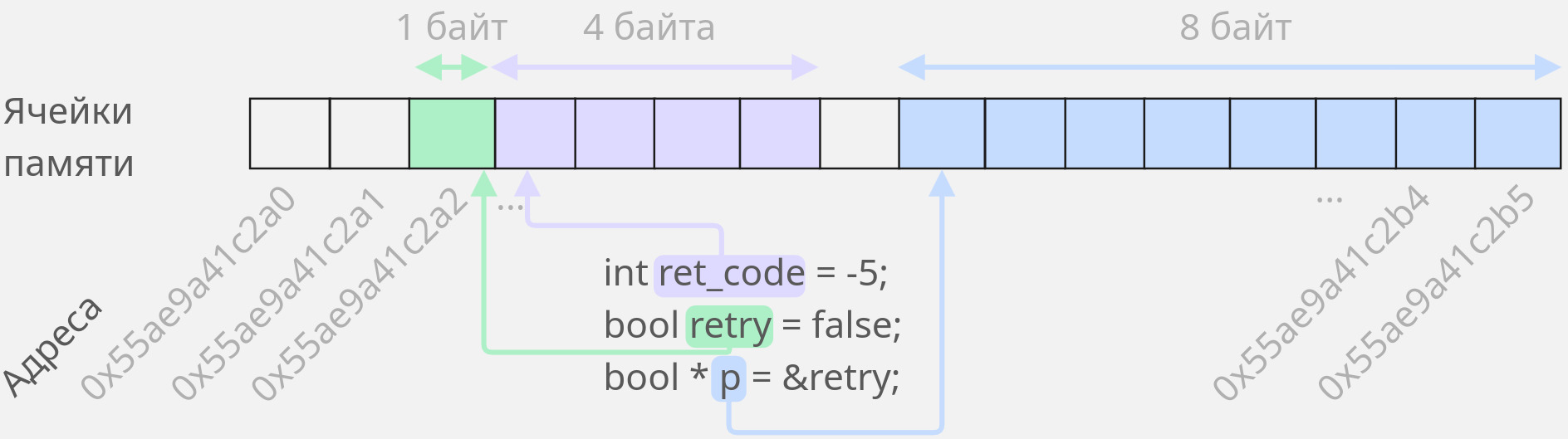 {.illustration} | ||
|
|

There was a problem hiding this comment.
Хотелось бы, чтобы читатель стал понимать как это всё устроено. Для этого предлагаю показать пример, как и можно посмотреть используемую переменными память:
import std;

template<class T>
void show_used_memory(const T* ptr, std::string_view name)
{
    const std::intptr_t address = reinterpret_cast<const std::intptr_t>(ptr);
    std::println("\n{}:", name);
    std::print("|");
    for (auto i = 0; i < sizeof(T); ++i)
        std::print("{:x}|", address + i);
    std::println("");
}

int main()
{
    int ret_code = -5;
    bool retry = false;
    bool * p = &retry;

    show_used_memory(&retry, "retry");
    show_used_memory(&ret_code, "ret_code");
    show_used_memory(&p, "p");
}
Возможный вывод:
retry:
|7ffdb51deffb|

ret_code:
|7ffdb51deffc|7ffdb51deffd|7ffdb51deffe|7ffdb51defff|

p:
|7ffdb51df000|7ffdb51df001|7ffdb51df002|7ffdb51df003|7ffdb51df004|7ffdb51df005|7ffdb51df006|7ffdb51df007|
Также предлагаю скорректировать картинку. Убрать пустое пространство между ret_code и p. Адреса ret_code и p должны быть кратны 8. Можно использовать адреса из примера, попался удачныф переход между ret_code и p.
There was a problem hiding this comment.
Лучше в колонку адраеса выводить:
import std;

template<class T>
void show_used_memory(const T* ptr, std::string_view name)
{
    const std::intptr_t address = reinterpret_cast<const std::intptr_t>(ptr);
    std::println("\n|{:<10}|{:x}|", name, address);
    for (auto i = 1; i < sizeof(T); ++i)
        std::println("|{:<10}|{:x}|", ' ', address + i);
}

int main()
{
    int ret_code = -5;
    bool retry = false;
    bool * p = &retry;

    show_used_memory(&retry, "retry");
    show_used_memory(&ret_code, "ret_code");
    show_used_memory(&p, "p");
}
Так нагляднее:
|retry     |7ffe3bc948eb|

|ret_code  |7ffe3bc948ec|
|          |7ffe3bc948ed|
|          |7ffe3bc948ee|
|          |7ffe3bc948ef|

|p         |7ffe3bc948f0|
|          |7ffe3bc948f1|
|          |7ffe3bc948f2|
|          |7ffe3bc948f3|
|          |7ffe3bc948f4|
|          |7ffe3bc948f5|
|          |7ffe3bc948f6|
|          |7ffe3bc948f7|
There was a problem hiding this comment.
Для этого предлагаю показать пример,
Добавила пример. Но не сюда, а в секцию про прибавление целого к указателю. Иначе будет непонятно, как этот пример кода работает.
Также предлагаю скорректировать картинку.
Готово.
cpp/cpp_chapter_0162/text.md
Outdated
|
|
||
| Разберем подробнее каждую из арифметических операций. Удобнее всего это делать на примере указателей на элементы сишных массивов. Заодно узнаем, что такое сишные строки. | ||
|
|
||
| ## Сишные массивы |
There was a problem hiding this comment.
Не стоит использовать такое наименование, лучше массивы фиксированного размера. Можно в тексте упомянуть, что такие массивы в обиходе называют сишными.
There was a problem hiding this comment.
Переименовала название секции.
p.s. Мы уже писали про массивы фиксированного размера здесь.
| ```cpp | ||
| std::println("Size of int: {} bytes", sizeof(int)); | ||
|
|
||
| const std::size_t n = 5; | ||
| int pow_series[n] = {16, 32, 64, 128, 256}; | ||
|
|
||
| std::println("\nArray of ints:"); | ||
|
|
||
| for (std::size_t i = 0; i < n; ++i) | ||
| { | ||
| std::println("Address: {}. pow_series[{}]={}", | ||
| static_cast<void *>(&pow_series[i]), i, pow_series[i]); | ||
| } | ||
| ``` | ||
| ``` | ||
| Size of int: 4 bytes | ||
|
|
||
| Array of ints: | ||
| Address: 0x7ffd9239f430. pow_series[0]=16 | ||
| Address: 0x7ffd9239f434. pow_series[1]=32 | ||
| Address: 0x7ffd9239f438. pow_series[2]=64 | ||
| Address: 0x7ffd9239f43c. pow_series[3]=128 | ||
| Address: 0x7ffd9239f440. pow_series[4]=256 | ||
| ``` |
There was a problem hiding this comment.
Можно использовать std::array<>, это более в духе современного C++:
import std;

int main()
{
    std::println("Size of int: {} bytes", sizeof(int));
    std::array<int, 5> pow_series = {16, 32, 64, 128, 256};

    std::println("\nArray of ints:");
    std::string line(30, '-');
    std::println("{}", line);
    std::println("{:>2} {:>16} {:>9}", 'i', "address", "value");
    std::println("{}", line);

    for (std::size_t i = 0; i < pow_series.size(); ++i)
    {
        std::println("{:>2} {:>16} {:>9}",
                     i, static_cast<void *>(&pow_series[i]), pow_series[i]);
    }
    std::println("{}", line);
}
Предлагаю использовать другое представление, в виде таблицы:
Size of int: 4 bytes

Array of ints:
------------------------------
 i          address     value
------------------------------
 0   0x7ffc79eadfa0        16
 1   0x7ffc79eadfa4        32
 2   0x7ffc79eadfa8        64
 3   0x7ffc79eadfac       128
 4   0x7ffc79eadfb0       256
------------------------------
Использование std::array и табличное представление на твоё усмотрение.
cpp/cpp_chapter_0162/text.md
Outdated
| 9621534751069176051 2054564862222048242 | ||
| ``` | ||
|
|
||
| ## Сишные строки |
There was a problem hiding this comment.
Нуль-терминированная строка такое название следует использовать название в заголовке. Также стоит дать ссылку на вики:
https://ru.wikipedia.org/wiki/%D0%9D%D1%83%D0%BB%D1%8C-%D1%82%D0%B5%D1%80%D0%BC%D0%B8%D0%BD%D0%B8%D1%80%D0%BE%D0%B2%D0%B0%D0%BD%D0%BD%D0%B0%D1%8F_%D1%81%D1%82%D1%80%D0%BE%D0%BA%D0%B0
Далее можно сказать, что в обиходе их часто называют сишными строками. И в отличии от массивов это действительно часто встречаемое сленговое слово (потому что эти строки используются повсеместно).
| Для нулевого элемента вместо этой записи можно использовать более лаконичную: | ||
|
|
||
| ```cpp | ||
| int * p = arr; |
There was a problem hiding this comment.
Да, для std::array<> такое не прокатит. Либо &arr[0] либо arr.begin(). Это аргумент не использовать std::array. Но в любом случае стоит напомнить читателю об std::array<> и сказать, что он аналогичен C-подобному массиву, но не требует держать отдельно размер массива и передавать его повсюду.
There was a problem hiding this comment.
Привела примеры и с array, и с сишным массивом.
cpp/cpp_chapter_0162/text.md
Outdated
|
|
||
| Но [какой тип](https://en.cppreference.com/w/cpp/language/string_literal.html) у самого литерала? Перед вами так называемая сишная строка, а по сути — сишный массив символов. У него тип `const char[n]`, где `n` — длина литерала + 1. Например, у литерала `"UART"` тип `const char[5]`. | ||
|
|
||
| Дополнительный элемент массива отводится под [завершающий ноль](https://en.wikipedia.org/wiki/Null_character) (terminating null character) — символ с кодом `U+0000`. Это маркер конца строки. Его не нужно добавлять к литералу вручную: компилятор сам запишет его в последний элемент. Завершающий ноль обозначается как `\0`: |
There was a problem hiding this comment.
С кодом 0. U+0000 - UTF определение нулевого символа. Его использование может ввести в заблуждение, что в C++ с UTF всё хорошо. Поэтому лучше сразу сделать акцент на значение 0 и литерал \0. Опционально можно показать как определить нулевой литерал в UTF:
template <class T>
void print_char(T ch)
{
    std::println("char size: {}, code: 0x{:x}", sizeof(ch), static_cast<std::size_t>(ch));
}

int main()
{
    print_char('\u0000');
    print_char(u8'\u0000');
    print_char(u'\u0000');
    print_char(U'\u0000');
}
Вывод:
char size: 1, code: 0x0
char size: 1, code: 0x0
char size: 2, code: 0x0
char size: 4, code: 0x0
There was a problem hiding this comment.
Поправила. Про ютф не буду))
cpp/cpp_chapter_0162/text.md
Outdated
| char null_char = '\0'; | ||
| ``` | ||
|
|
||
| При передаче в функцию сишная строка приводится к указателю (array-to-pointer decay). Но в отличие от массива, она не требует передачи дополнительного параметра — длины. Не обязательно знать длину строки, чтобы избежать выхода за ее границы: достаточно помнить про завершающий символ `\0`. |
There was a problem hiding this comment.
Стоит показать, что определение нуль терминированной строки равносильно определению массива символов, просто гораздо удобнее:
    const char* c_str = "C-like string";
    const char c_arr[] = {'C', '-', 'l', 'i', 'k', 'e', ' ', 's', 't', 'r', 'i', 'n', 'g', '\0'};

    std::println("{}", c_str);
    std::println("{}", c_arr);
Отсюда следствие, что для определения строки без териминирующего 0, нужно определить её как массив символов.
| }; | ||
|
|
||
| std::uint64_t * p = seed; | ||
| std::println("{} {}", *p, p[1]); |
There was a problem hiding this comment.
Нужно показать как вычислить размер C-подобного массива:
    int arr[] = {10, 20, 0, -500, 8};
    std::println("{}", sizeof(arr) / sizeof(*arr));
5
Дополнительно в качестве задания можно спросить, какое значение будет напечатано, если будет ошибка компиляции или исполнения, то напечатать err:
    int arr0[0] = {};
    std::println("{}", sizeof(arr0) / sizeof(*arr0));
0
Стоит пояснить, что ошибки и UB здесь нет так как подобные выражения вычисляются на этапе компиялции и sizeof(*arr0) не требует обращения к первому (несуществующему) элементу массива.
    constexpr auto len = sizeof(arr0) / sizeof(*arr0);
    std::println("{}", len);
Кстати, в Си есть специальная техника по использованию массивов нулевой длины. Она позволяет хранить структуры и массив переменной длины одним блоком:
https://gcc.gnu.org/onlinedocs/gcc/Zero-Length.html
There was a problem hiding this comment.
Стандарт C++ говорит, что заводить массив длины 0 незаконно. А эта штука - гцц расширение.
Про определение размера сишного размеры мы уже писали.
There was a problem hiding this comment.
Вариант sizeof(arr) / sizeof(*arr) или sizeof(arr0) / sizeof(arr[0]) более 'каноничный', так как позволяет не указывать тип элемента прямо. В любом случае предлагаю ещё раз упомянуть этот момент там, где я предлагаю добавить про современный C++.
P.S. Кстати std::array<T, 0> может иметь размер 0.
There was a problem hiding this comment.
Более каноничный способ добавила в главу 14.2. В эту главу добавила задачу "что выведет этот код" про длину со ссылкой на раздел 14.2 про определение длины.
cpp/cpp_chapter_0162/text.md
Outdated
| Когда к указателю прибавляется целое число, то хранящийся в нем адрес увеличивается на соответствующее значение, умноженное на размер типа данных. Если прибавить к указателю число, не превышающее длину массива, то он будет ссылаться на один из последующих элементов: | ||
|
|
||
| ```cpp | ||
| const std::size_t n = 4; |
| Синтаксис языка позволяет применять к указателю оператор `[]`, чтобы через него обращаться к элементам массива: | ||
|
|
||
| ```cpp | ||
| std::uint64_t seed[] = { |
There was a problem hiding this comment.
Тут стоит пояснить, что размер массива фиксированной длины можно опустить, если инициализации массива происходит при обявлении. Компилятор сам вычислит размер массива.
There was a problem hiding this comment.
Про это было в 14.2. И ссылка на раздел про длину уже есть выше по этой главе.
 Microvenator
force-pushed
the
cpp-chapter-16-2
branch
from
Microvenator
force-pushed
the
cpp-chapter-16-2
branch
from
81d8842 to
ea03e8f
Compare
| ```cpp | ||
| import std; | ||
|
|
||
| std::size_t size_ptr(int * buf) | ||
| { | ||
| return sizeof(buf); | ||
| } | ||
|
|
||
| std::size_t size_arr(int buf[]) | ||
| { | ||
| return sizeof(buf); | ||
| } | ||
|
|
||
| int main() | ||
| { | ||
| int raw_data[5] = {}; | ||
| std::size_t a = &raw_data[4] - raw_data; | ||
| std::size_t b = sizeof(raw_data); | ||
|
|
||
| std::println("{} {} {} {}", | ||
| a, | ||
| b, | ||
| b == size_ptr(raw_data), | ||
| b == size_arr(raw_data)); | ||
| } | ||
| ``` | ||
|
|
||
| ```consoleoutput {.task_source #cpp_chapter_0162_task_0050} | ||
| ``` | ||
| . {.task_hint} | ||
| ```cpp {.task_answer} | ||
| 4 20 false false | ||
| ``` |
There was a problem hiding this comment.
Это неудачная задача. Имеется две проблемы с функцией size_arr():
- Из-за неё не компилируется код в плейграунде.
- Название функции
size_arr()не соответствует тому, что она делает.
Ниже 4 разных варианта на замену size_arr(), в зависимости от того, что требуется:
import std;

std::size_t size_ptr(int * buf)
{
    return sizeof(buf);
}

// вместо size_arr [1]
template<class A>
std::size_t size_ptr2(A _unused)
{
    return sizeof(A);
}

// вместо size_arr [2]
template<class Item, std::size_t Count>
std::size_t bytes_count(const Item (&_unused)[Count])
{
    return sizeof(int[Count]);
}

// вместо size_arr [3]
template<class Item, std::size_t Count>
std::size_t array_size(const Item (&_unused)[Count])
{
    return Count;
}

// вместо size_arr [4]
// std::size()

int main()
{
    const std::size_t sz = 5;
    int raw_data[sz] = {};
    //std::size_t items = &raw_data[sz - 1] - raw_data;
    std::size_t items = std::end(raw_data) - std::begin(raw_data);
    std::size_t bytes = sizeof(raw_data);

    std::println("{} {} \npointer size: {} \npointer size: {} \nbytes count: {} \narray size: {} \narray size: {}",
                 items,
                 bytes,
                 size_ptr(raw_data),
                 size_ptr2(raw_data),
                 bytes_count(raw_data),
                 array_size(raw_data),
                 std::size(raw_data)
        );
}There was a problem hiding this comment.
Просто убрала size_arr.
|
|
||
| ---------- | ||
|
|
||
| ## Резюме |
There was a problem hiding this comment.
ИМХО, главу стоит расширить.
- Стоит рассказать как передавать Си-подобные массивы по ссылке:
import std;

template<class Item, std::size_t Count, class Filler>
void fill_array(Item (&arr)[Count], Filler filler)
{
    for (std::size_t i = 0; i < Count; ++i)
        arr[i] = filler(i);
}

template<class Item, std::size_t Count>
void print_array(const Item (&arr)[Count])
{
    std::println("");
    for (const Item *ptr = arr, *end = arr + Count; ptr < end; ++ptr)
        std::print("{} ", *ptr);
}

char get_alphabet_char(std::size_t i)
{
    static const char alphabet[] = "AaBbCcDdEeFfGgHhIiJjKkLlMmNnOoPpQqRrSsTtUuVvWwXxYyZz";
    const std::size_t pos = i % (sizeof(alphabet) / sizeof(*alphabet) - 1);
    return alphabet[pos];
}

char get_alphabet_lower_case_char(std::size_t i)
{
    return get_alphabet_char(2 * i + 1);
}

char get_alphabet_upper_case_char(std::size_t i)
{
    return get_alphabet_char(2 * i);
}

int main()
{
    const std::size_t alphabet_size = 26;
    char alphabet[alphabet_size] = {};

    fill_array(alphabet, get_alphabet_lower_case_char);
    print_array(alphabet);

    fill_array(alphabet, get_alphabet_upper_case_char);
    print_array(alphabet);
}There was a problem hiding this comment.
Как передача по ссылке связана с адресной арифметикой?
cpp/cpp_chapter_0162/text.md
Outdated
| ---------- | ||
|
|
||
| ## Резюме | ||
| - Сишная строка — это массив `char`, завершенный символом `\0`. |
There was a problem hiding this comment.
- Этот 'прекрасный' мир Си-легаси стоит разбавить современным C++:
import std;

int main()
{
    int arr[] = {21, 8, 12, -4, 7, 7, 0};
    char str[] = "Use modern C++!";

    // вместо Си-шного метода вычисления размера использовать std::size()
    std::size_t legacy_size = sizeof(arr) / sizeof(*arr);
    std::size_t modern_size = std::size(arr);
    std::println("{} {}", legacy_size, modern_size);

    std::println("");
    // классический обход по указателю:
    for (const int *ptr = arr, *end = arr + legacy_size; ptr != end; ++ptr)
        std::print("{} ", *ptr);

    std::println("");
    // можно заменить на итераторы, это полезно при написании обобщенного кода,
    // когда требуется уметь работать с контейнерами разных типов
    for (auto iter = std::begin(arr), end = std::end(arr); iter != end; iter = std::next(iter))
        std::print("{} ", *iter);

    std::println("");
    // И конечно же для Си-шных строки и массивов доступен range-based for
    for (char ch: str)
        std::print("{} ", ch);

    // Си-шные массивы можно превратить в std::array
    // можно опустить тип элементов и размер массива
    std::array modern_array = std::to_array(arr);
    std::println("\n{}", modern_array);

    // Си-шные строки можно превратить в std::string_view
    std::string_view modern_str = std::string_view(str, std::size(str));
    std::println("{}", modern_str);
}- Стоит сказать, что работа с указателями доступна также для стандартных контейнеров:
std::vector,std::array,std::string,std::string_viewиstd::span. Это может быть полезно для взаимодействия с легаси либо Си кодом:
import std;
#include <uchar.h>

// типа легаси код
long * fill(long *ptr, size_t count, long value)
{
    for (long *end = ptr + count; ptr != end; ++ptr)
        *ptr = value;

    return ptr - count;
}

int main()
{
    std::vector<long> buf(8, 0xbad);
    std::span<long> slice{buf.begin() + 2, 4};
    fill(slice.data(), slice.size(), 0xeffe);

    for (long& it: buf)
        std::print("{:X} ", it);
}
Вывод:
BAD BAD EFFE EFFE EFFE EFFE BAD BAD
There was a problem hiding this comment.
Этот 'прекрасный' мир Си-легаси стоит разбавить современным C++
Про std::span, std::to_array и преимущества std::array мы рассказывали в 14.2. Это не относится к адресной арифметике. Если хочешь, могу тот раздел потом дополнить еще примером с итераторами, который ты написал.
Стоит сказать, что работа с указателями доступна также для стандартных контейнеров
Это будет в следующей подглаве.


Главу пока ревьюить рано! Реквест открыт для удобства @khva