Official implementation of the paper:
"Wavelet Transform Attention Network for Low-Exposure THz Image Enhancement in Rydberg Atomic Systems"
Abstract: This work proposes a novel Full-Wavelet Attention Network (FWMNet) to address the challenges of low exposure and high noise in Rydberg atom THz imaging systems. By integrating discrete wavelet transform with channel-spatial attention mechanisms.

- Pretrained model:
- Datasets:


# Create conda environment
conda create -n fwmnet python=3.10

# Activate environment
conda activate fwmnet

# Install dependencies
pip install -r requirements.txt

# train
python train.py

# eval
python evaluate_fwmnet.py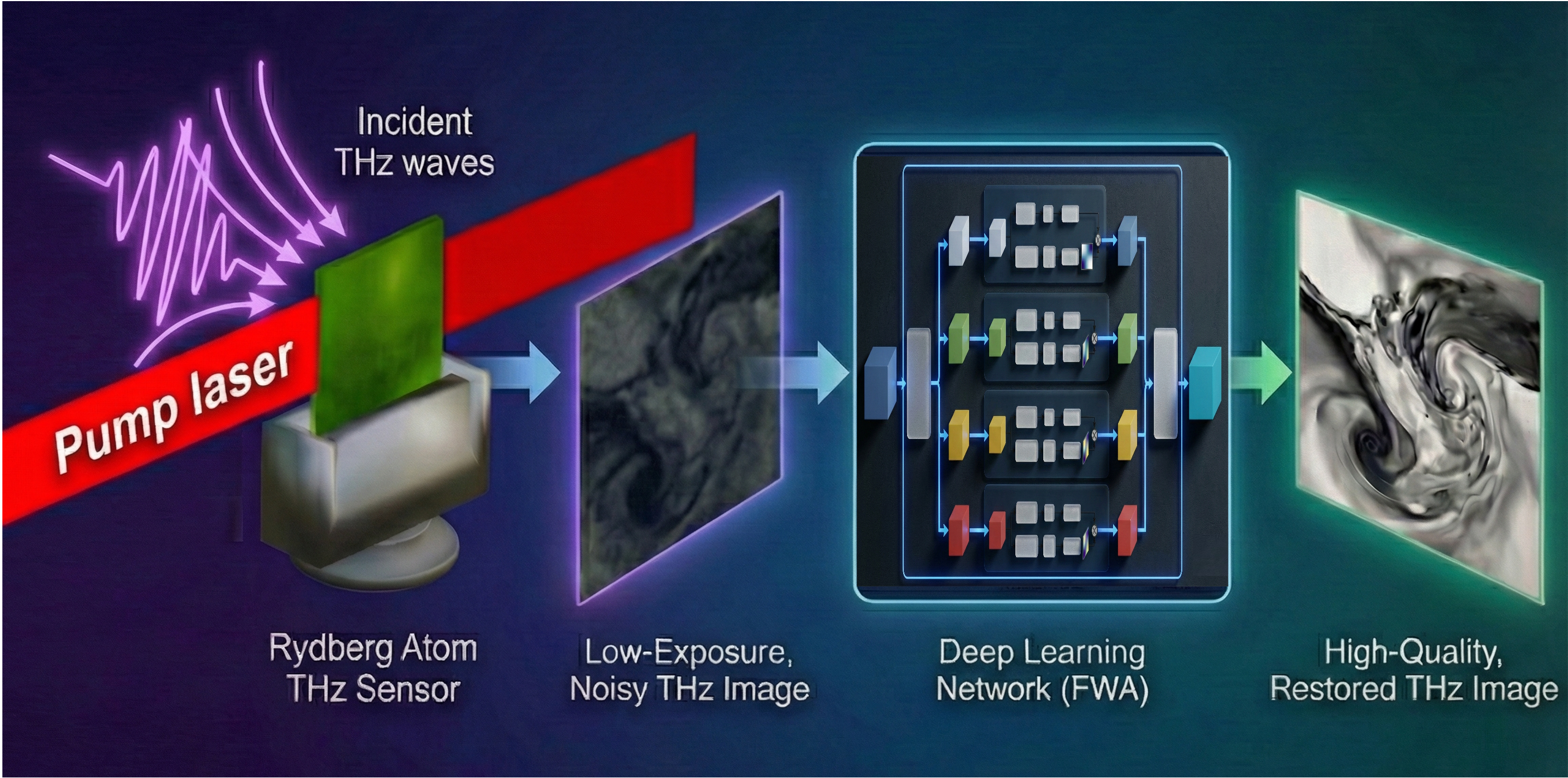
Terahertz (THz) radiation (0.1-10 THz) has emerged as a powerful modality for security screening and biomedical imaging due to its unique properties: non-ionizing nature, material penetration capability, and molecular fingerprinting. However, traditional THz imaging systems face significant limitations in achieving both high speed and high quality simultaneously.
Rydberg atom-based THz detection represents a breakthrough technology that leverages quantum effects to convert invisible THz field information into visible fluorescence signals through atomic energy level transitions. This "THz-to-optical" conversion mechanism bypasses the traditional trade-offs in direct THz detection, enabling high-resolution, high-frame-rate imaging at room temperature.
Despite the theoretical advantages of Rydberg atom detection, practical high-speed imaging (e.g., 100 fps) introduces critical challenges:
- Severe underexposure: Millisecond-scale exposure times drastically reduce signal photon counts
- Low signal-to-noise ratio (SNR): Readout noise and fluorescence background degrade image quality
- Detail loss: Fine structures and textures are overwhelmed by noise
- Dynamic imaging limitations: Quantitative analysis of rapid processes becomes challenging
These limitations significantly impact the practical application of Rydberg atom THz imaging in real-world scenarios such as security inspection and biomedical diagnostics.
We present a novel Full-Wavelet Attention Network (FWMNet) that synergistically integrates wavelet transform with attention mechanisms for high-fidelity THz image restoration.
| Component | Function | Innovation Value |
|---|---|---|
| Discrete Wavelet Transform (DWT) | Decomposes images into multi-scale frequency subbands (LL, LH, HL, HH) | Natural separation of signal and noise with physical priors |
| Dual Attention Mechanism | Adaptive feature weighting through channel and spatial attention | Intelligent feature selection and noise suppression |
| Selective Kernel Feature Fusion | Dynamic multi-scale feature aggregation | Preserves both global structure and local textures |
| Recursive Residual Design | Progressive signal decomposition | Enables deep network construction with stable training |
- PSNR improvement: +7.23 dB (from 18.01 dB to 29.75 dB)
- SSIM enhancement: +8.91% (from 0.76 to 0.93)
- Training efficiency: Achieves excellent performance with only 300 image pairs
- Generalization capability: Robust performance across different imaging scenarios
Compared to traditional methods (histogram equalization, Gaussian filtering) and prior deep learning approaches, FWMNet demonstrates superior detail preservation and artifact suppression while maintaining natural visual quality.
The method successfully demonstrates real-time capability in capturing dynamic processes, particularly in fluid interface analysis:
- Clear boundary visualization: Distinct phase separation between immiscible liquids
- Interface oscillation analysis: Quantified spatiotemporal dynamics at 10.1 Hz fundamental frequency
- Amplitude measurement: 0.7 mm oscillation amplitude revealing viscous-capillary instabilities
Carefully curated paired dataset acquired through controlled acquisition protocol:
- 300 image pairs (270 training, 30 testing)
- Precise alignment: Same scene captured at different frame rates (100+ fps vs 10 fps)
- Diverse samples: Metal targets, optical elements, fluidic devices
- Quality assurance: Strict spatial alignment and content verification
Systematic evaluation confirms optimal configuration:
- 64 convolutional filters with 4-level depth provides best performance-complexity tradeoff
- Dual attention mechanism significantly improves feature selection
- Multi-scale feature fusion enhances both local and global information integration
- First application of wavelet-attention networks to Rydberg atom THz high-speed imaging
- Unpaired training strategy enabling practical deployment with limited data
- Spatial-frequency cooperative learning paradigm for optimal detail preservation
- Real-time dynamic imaging capability validated through fluid flow experiments
- Optimization of inference speed for real-time processing applications
- Extension to biological tissue imaging and other emerging THz applications
- Integration with computational imaging techniques for further performance enhancement
- Exploration of multi-modal sensing combining THz with other imaging modalities
This work establishes a new benchmark for THz image enhancement and demonstrates the potential of deep learning-powered computational imaging for advancing quantum sensing technologies.